Introduction / Chapitre 2
Sylviculture de Tama
Environ 70 % des forêts de Tokyo se trouvent dans la région de Tama, à l'ouest de la métropole, soit quelque 53 000 hectares.[1] Dans les forêts privées de Tama, 60 % sont des plantations de cèdre du Japon, de hinoki et d'essences similaires, plantées pour la plupart entre le milieu des années 1950 et le début des années 1970.[1]
Les forêts de Tama aujourd'hui
Une époque où l'on plantait, une époque où l'on ne plante plus
Les plantations dépassaient 1 500 hectares par an en 1960. Elles chutèrent ensuite brutalement, jusqu'à 6 hectares seulement en 2003.[1] En termes de classes d'âge, les montagnes sont couvertes d'arbres de la même génération, avec presque aucune jeune forêt.
| Exercice | Surface nouvellement plantée | Situation |
|---|---|---|
| 1960 | Plus de 1 500 ha | Pic des plantations d'extension |
| 2003 | 6 ha | Point le plus bas |
| Exercice 2022 | 48 ha | Le programme de coupe et de replantation se poursuit |
Source : Gouvernement métropolitain de Tokyo, Plan de croissance circulaire de la sylviculture et de l'industrie du bois (révisé)[1]
Pourquoi les arbres ne sont pas coupés
Une longue période de prix du bois déprimés et la hausse du coût de la main-d'œuvre ont rendu la sylviculture non rentable, si bien que la récolte des cèdres et des hinoki de plus de 50 ans, pourtant assez gros pour être utilisés, s'est arrêtée.[3] Le relief escarpé augmente les coûts d'exploitation, et les entreprises forestières de Tokyo sont petites, avec des marges faibles.[1]
Jusqu'à la ville, sous forme de pollen
Les cèdres non exploités ont aussi des effets sur la vie urbaine. Une enquête de 2017 a estimé la prévalence de l'allergie au pollen de cèdre à Tokyo à 48,8 %, contre 28,2 % lors de l'enquête de l'exercice 2006.[3] La Fondation pour le développement de l'agriculture, de la sylviculture et de la pêche de Tokyo mène un programme d'abattage des cèdres et de replantation de variétés à faible production de pollen. De l'exercice 2006 à l'exercice 2020, ce programme a expédié un total cumulé de 257 000 mètres cubes de bois.[3]
Forêts naturelles et forêts domaniales
Dans la forêt domaniale du mont Takao, à Hachioji, une forêt naturelle de sapins est classée communauté végétale protégée. La zone se situe à la limite entre l'étage tempéré froid et l'étage tempéré chaud, et ses forêts naturelles comprennent le hêtre bleu du Japon (inubuna), le chêne konara, le sapin et la pruche.[4]
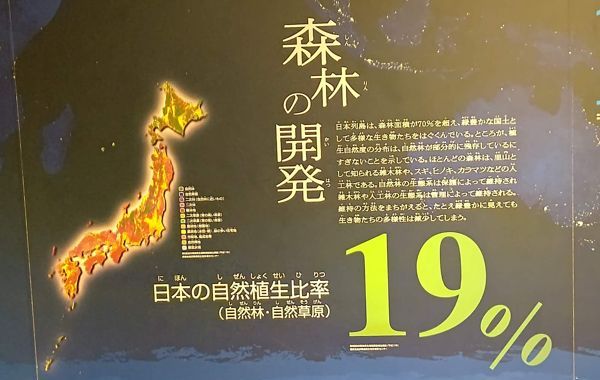
Across Japan as a whole, vegetation left in its natural state is not common. An exhibit panel I saw at a museum in Ueno Park showed that while forests cover more than 70% of Japan, most of them are satoyama coppice woodland or plantations of sugi, hinoki, larch and the like, and that "natural vegetation"—natural forest and natural grassland combined—makes up 19%. The panel cites the Ministry of the Environment's National Survey on the Natural Environment as its source.
Protection forests: woods you cannot fell freely
Protection forests (hoan-rin) are forests whose public functions, such as storing water, preventing landslides or breaking the wind, are especially important. Under the Forest Act, the Minister of Agriculture, Forestry and Fisheries or a prefectural governor designates them. There are 17 types by purpose, including water-source conservation and erosion control. Once designated, felling trees and changing the shape of the land are regulated[5]. At the end of FY2023 Japan had 12.29 million ha of protection forest: 49.1% of its forests and 32.5% of its land area[6].
The system goes back to the Meiji era. After the great floods of 1896, the Forest Act was enacted in 1897. After the war, the Temporary Measures Act for Protection Forest Improvement of 1954 drove designations forward, renewed every ten years[7].
| Restrictions after designation | Benefits in return |
|---|---|
| Felling requires a permit or notification | Exempt from fixed property tax, real estate acquisition tax and special land holding tax |
| No conversion to other uses such as housing | For inheritance and gift tax, the valuation is reduced by 30–80% depending on how strict the felling limits are |
| Changing the land, for example building work roads, requires a permit | |
| Felled areas must in principle be replanted |
Source: Saitama Prefecture, "About protection forests"[8]. The system rests on the nationwide Forest Act.
In Tokyo, the area of the Tokyo Metropolitan Forestry Office, covering 15 Tama municipalities, held 14,838 ha of protection forest as of 31 March 2019. Of this, 12,478 ha, about 84%, is water-source conservation forest. National forest accounts for 935 ha and non-national forest for 13,903 ha[9].
| Type | Forêts domaniales | Non-national forest | Total |
|---|---|---|---|
| Water-source conservation | 485 | 11,993 | 12,478 |
| Erosion control | 296 | 1,316 | 1,612 |
| Landslide prevention | 0 | 51 | 51 |
| Windbreak | 0 | 1 | 1 |
| Drought prevention | 0 | 7 | 7 |
| Rockfall prevention | 0 | 35 | 35 |
| Public health (recreation) | 154 | 429 | 583 |
| Scenic | 0 | 71 | 71 |
| Total | 935 | 13,903 | 14,838 |
Unit: ha. As of 31 March 2019. A further 10 ha of non-national fire-prevention forest and 2,293 ha of forest designated for two purposes at once are excluded from the totals. Source: Tokyo Metropolitan Forestry Office, "Business overview, 2019 edition"[9].
Forests in the same area total 52,867 ha (as of 1 April 2019), so protection forest is about 28% of the forest[9]. That is lower than the national 49.1%, but the dates and scope differ, so treat it as a rough comparison.
In FY2018 the Forestry Office handled 9 felling permits (30.4 ha), 37 work permits and 92 thinning notifications (112.8 ha). Inquiries about whether a given plot lies in protection forest numbered 379, covering 4,023 parcels[9]. The metropolitan government manages 10 metro-owned public-health protection forests, 239.4 ha in all, in Hachioji, Akiruno and Hinohara[9].
The water-source forests managed by the Tokyo Waterworks Bureau are also protection forest. They cover 25,666 ha across Okutama and, in Yamanashi, Koshu, Tabayama and Kosuge; Tokyo Prefecture took them over from the imperial forests and began managing them in 1901. They are designated as water-source conservation, erosion control and public-health protection forest[10]. The Yamanashi part is not in the Tama table above.
The Tokyo figures come from the 2019 business overview; the latest areas have not been confirmed. Protection forests on the islands and in the 23 wards have not been researched here.
Les travailleurs et l'argent de la sylviculture
Travailleurs forestiers : 44 000 dans tout le pays
Le nombre de personnes travaillant dans la sylviculture à l'échelle nationale (travailleurs forestiers) baisse depuis longtemps et s'élevait à environ 44 000 en 2020. La part des 65 ans et plus (taux de vieillissement) est de 25 %, au-dessus des 15 % de l'ensemble des secteurs. En revanche, la part des moins de 35 ans (taux de jeunes) augmente depuis 1990 et atteint 17 %.[11]
Avant le lancement du programme national « Green Employment », environ 2 000 personnes par an en moyenne entraient dans la sylviculture ; depuis, elles sont environ 3 200 par an.[11] Un dispositif permettant de commencer à travailler tout en étant formé sur le terrain attire davantage de nouveaux venus.
La sylviculture sur le terrain à Tokyo
Selon un rapport du Gouvernement métropolitain de Tokyo sur les entreprises forestières de la ville (54 répondantes), l'âge moyen des travailleurs de terrain était de 45,7 ans et environ 27 % avaient 34 ans ou moins. Au FY2024, 21 personnes sont arrivées et 19 sont parties, soit un taux de maintien sur un an de 91,8 %. Les personnes ayant 15 ans d'expérience ou moins représentent 57,3 %.[12]
La tranche de salaire la plus fréquente était « de 4 millions à moins de 4,5 millions de ¥ », avec 26,2 %, et environ 46 % gagnaient moins de 4 millions de ¥. Près des trois quarts des entreprises interrogées avaient augmenté les salaires par rapport à l'année précédente.[12]
Danger et conditions de travail
La sylviculture reste un métier très dangereux. Le nombre annuel de morts et de blessés pour 1 000 travailleurs (taux d'accidents pour 1 000 travailleurs par an) était en 2022 de 23,5 dans la sylviculture contre 2,3 pour l'ensemble des secteurs, soit environ 10 fois plus. Le salaire annuel moyen était de 3,61 millions de ¥ dans la sylviculture et de 4,58 millions de ¥ tous secteurs confondus.[13]
Les façons de travailler évoluent. La part des personnes travaillant 210 jours ou plus par an est passée de 9 % au FY1985 à environ 70 %, et celle des salariés mensualisés de 2 % à environ 30 %.[13] L'emploi se rapproche d'une forme stable, permettant de travailler toute l'année.
Mécanisation : les machines forestières à haut rendement
Abattre, ébrancher, tronçonner à longueur fixe, débarder. Des tâches autrefois faites à la main, à la tronçonneuse et au câble, sont désormais assurées par des machines spécialisées. Au FY2024, on comptait dans tout le pays 16 431 machines forestières à haut rendement, soit 1 365 de plus que l'année précédente et environ 2,3 fois les 7 089 d'il y a dix ans (FY2014).[14]
| Machine | Ce qu'elle fait | Nombre (FY2024) |
|---|---|---|
| Porteur (forwarder) | Charge les grumes coupées sur sa benne et les sort de la forêt | 5,186[14] |
| Processeur | Ébranche les arbres abattus et les tronçonne à longueur fixe | 2,348[14] |
| Abatteuse (harvester) | Abat les arbres sur pied, puis les ébranche et les tronçonne | 2,272[14] |
| Câble-mât pivotant (swing yarder) | Tire les grumes au câble depuis le bas ou le haut de la pente | 1,151[14] |
La description des machines est générale. Les nombres sont des totaux nationaux ; les chiffres pour Tokyo n'ont pas pu être vérifiés.
La sylviculture est-elle rentable ?
Selon une estimation de l'Agence des forêts, l'exploitation d'1 hectare de plantation de sugi (cèdre du Japon) de 50 ans rapporte 3,98 millions de ¥ de ventes de grumes. Mais, une fois déduits les coûts d'abattage et de transport, la part du propriétaire (prix du bois sur pied) n'est que de 1,37 million de ¥. Planter ensuite des plants et commencer à les élever coûte 2,75 millions de ¥, plus que cette part. Le simple fait de couper et de replanter met le propriétaire dans le rouge.[15]
L'Agence des forêts estime que la « nouvelle sylviculture », qui combine mécanisation et plantation plus économe en main-d'œuvre, pourrait dégager un bénéfice de 710 000 ¥ avec les mesures disponibles aujourd'hui, et de 1,13 million de ¥ avec de nouvelles technologies.[15] La baisse de la part du propriétaire par rapport au passé est résumée dans « Les prix du bois d'autrefois », en Annexe.
Les montants par hectare sont des estimations de l'Agence des forêts pour l'ensemble du Japon, et non des chiffres propres aux forêts de Tokyo.
Comment assurer la relève
Les piliers pour attirer des travailleurs sont l'aide à l'emploi assortie de formation, comme le programme national « Green Employment », et l'amélioration des conditions, comme les salaires et l'emploi à l'année.[11][13] À Tokyo, la plupart des entreprises ont augmenté les salaires, et les arrivées et les départs s'équilibrent à peu près.[12] Les informations pour trouver un emploi forestier à Tokyo et les contacts pour participer bénévolement à l'entretien des forêts sont rassemblés dans les liens de l'Annexe.
Forests, wood and taxes
Forest environment tax: ¥1,000 a year from Tokyo residents too
Taxes are also used to care for forests. Since fiscal 2024, a "forest environment tax" of ¥1,000 a year has been collected from each person who pays resident tax. Some 60 million people pay it, and revenue is expected to be about ¥60 billion a year.[16]
The tax is distributed to municipalities and prefectures as the "forest environment transfer tax," which began ahead of it in fiscal 2019. It is allocated by three criteria: the area of privately owned planted forest, the number of forestry workers, and population. Criticism that the large population weight sends much of it to urban areas with few forests led to a revision from fiscal 2024 to 55% planted forest area, 20% forestry workers and 25% population.[16]
| Allocation criterion | Until FY2023 | From FY2024 |
|---|---|---|
| Private planted forest area | 50% | 55% |
| Forestry workers | 20% | 20% |
| Population | 30% | 25% |
Source: Dai-ichi Life Research Institute (December 6, 2024)[16]
Even the 23 wards, which have almost no forest, receive this transfer tax. They can spend it either on using wood within their own ward or on helping regions that have forests. In fiscal 2023, for example, Suginami Ward used it for school rebuilding, chairs and shelves for childcare facilities and repairs to wooden playground equipment in parks, as well as a carbon offset project in partnership with another municipality and thinning experiences for children.[17]
Rules for using wood in public buildings
In 2010 the national government enacted the Act on Promotion of Use of Wood in Public Buildings, setting a policy of using wood in national and local government buildings. A revision in October 2021 renamed it the Act on Promotion of Use of Wood in Buildings to Contribute to Realizing a Decarbonized Society, and extended it to all buildings, including private ones.[18] The share of public buildings built of wood, 8.3% when the law was enacted, reached 15.9% in fiscal 2024; for low-rise public buildings of three stories or fewer it was 33.4%.[19] That also means more than half are still not built of wood.
Subsidies for using local wood: Tokyo Metropolis and Minato Ward
Through its "Tama Timber Use Promotion Project," the Tokyo Metropolitan Government subsidizes facilities that wards, cities, towns and villages build or improve using Tama timber—timber construction, wood interiors, wooden playground equipment, and wooden furniture and exterior structures. The subsidy covers half the cost, up to ¥30 million per municipality (as of the fiscal 2023 revision).[20]
There are also systems in which a ward requires the use of wood. Minato Ward's "Minato Model CO2 Fixation Certification System" asks developers building structures of 5,000 m² or more of total floor area in the ward to use 0.001 m³ of domestic timber per square meter of floor area. It also encourages the use of wood from regional municipalities that have signed agreements with the ward ("agreement timber"). It began in October 2011.[21] It is a mechanism by which a central-city ward with no forests channels money to regional forests through its buildings.
I have not confirmed the latest conditions of the Tokyo subsidy, the amounts of the forest environment transfer tax distributed to the 23 wards as a whole or to Tokyo and the Tama municipalities, or the wood-construction rate of public buildings in Tokyo.
Sources
- 東京都産業労働局「林業・木材産業循環成長対策 変更事業構想」 PDF
- 東京都「森づくり推進プラン」表1-1(原典:令和2年版 東京の森林・林業) PDF
- 公益財団法人東京都農林水産振興財団 説明資料 PDF
- 林野庁関東森林管理局「多摩森林計画区の概要」 PDF
- 林野庁「保安林制度」(水源林の保全) Lien
- 林野庁「令和6年度 森林・林業白書」第1部第3章第1節 Lien
- 林野庁 資料「保安林制度の沿革」 Lien
- 埼玉県「保安林について」 Lien
- 東京都森林事務所「事業概要 令和元年版」 Lien
- 林野庁「水源の森百選 東京都水道水源林」 Lien
- 林野庁「林業労働力の動向」 Lien
- 東京都森林事務所『林業関係労働力実態分析報告書』(令和7年度、令和8年3月) PDF
- 林野庁「一目でわかる林業労働(データ編)」 PDF
- 林野庁「高性能林業機械の保有状況」 Lien
- 林野庁『令和5年度 森林・林業白書』第2章(林業経営の効率化) Lien
- 第一生命経済研究所「6,000万人が納税する森林環境税」(2024年12月6日) Lien
- 杉並区「森林環境譲与税の使途」(令和5年度決算) PDF
- 林野庁「公共建築物等木材利用促進法」 Lien
- 林野庁「公共建築物の木造率について」(令和8年3月30日更新) Lien
- 東京都産業労働局「公共施設における多摩産材使用事例集 ver.6」 PDF
- 港区「みなとモデル二酸化炭素固定認証制度実施要綱」 PDF