Introduction / Chapitre 6
Transformation et génie civil
Les grumes ne peuvent pas être utilisées telles quelles. Il faut les fendre, les scier ou les contrecoller. Ce chapitre retrace la manière dont le bois a été transformé de l'époque d'Edo à nos jours, et comment il a servi dans des travaux de génie civil comme les poteaux électriques et le remblaiement.
Travailler le bois
Fendre : plus ancien que la scie
Le cèdre du Japon pousse droit et se fend facilement dans le sens du fil. On peut le fendre jusqu'à une épaisseur d'environ 5 mm, et il servait à fabriquer tonneaux et cuves.[1] Les anciennes scies japonaises étaient des outils de tronçonnage, peu adaptés au sciage du bois dans le sens de la longueur.[2] C'est pourquoi les bois faciles à fendre étaient si appréciés.
Scier : l'oga et le maebiki-oga
L'oga, une scie à refendre le bois dans le sens de la longueur, est arrivé de Chine aux XIVe et XVe siècles (milieu de l'époque de Muromachi). Sa lame, d'environ 2 m de long et 5 cm de large, était tendue dans un cadre et maniée par deux personnes.[2] Il permettait de débiter facilement des planches larges et minces, transformant la fabrication des planches et le travail du bois.[2]
Au début de l'époque d'Edo apparut et se répandit le maebiki-oga, manié par une seule personne.[2] Les artisans qui sciaient les grumes en planches et en bois équarris étaient appelés kobiki, scieurs de long.
| Méthode | Époque | Fonction |
|---|---|---|
| Fendage | Depuis l'Antiquité | Fendre des grumes droites dans le sens de la longueur ; douelles pour tonneaux et cuves[1] |
| Oga (à deux) | Introduit aux XIVe-XVe siècles | Refendre des planches larges et minces[2] |
| Maebiki-oga (à une personne) | Répandu au début d'Edo | Un scieur refend seul[2] |
| Lamellé-collé / CLT | Aujourd'hui | De petites pièces contrecollées en grands poteaux, poutres et murs[3] |
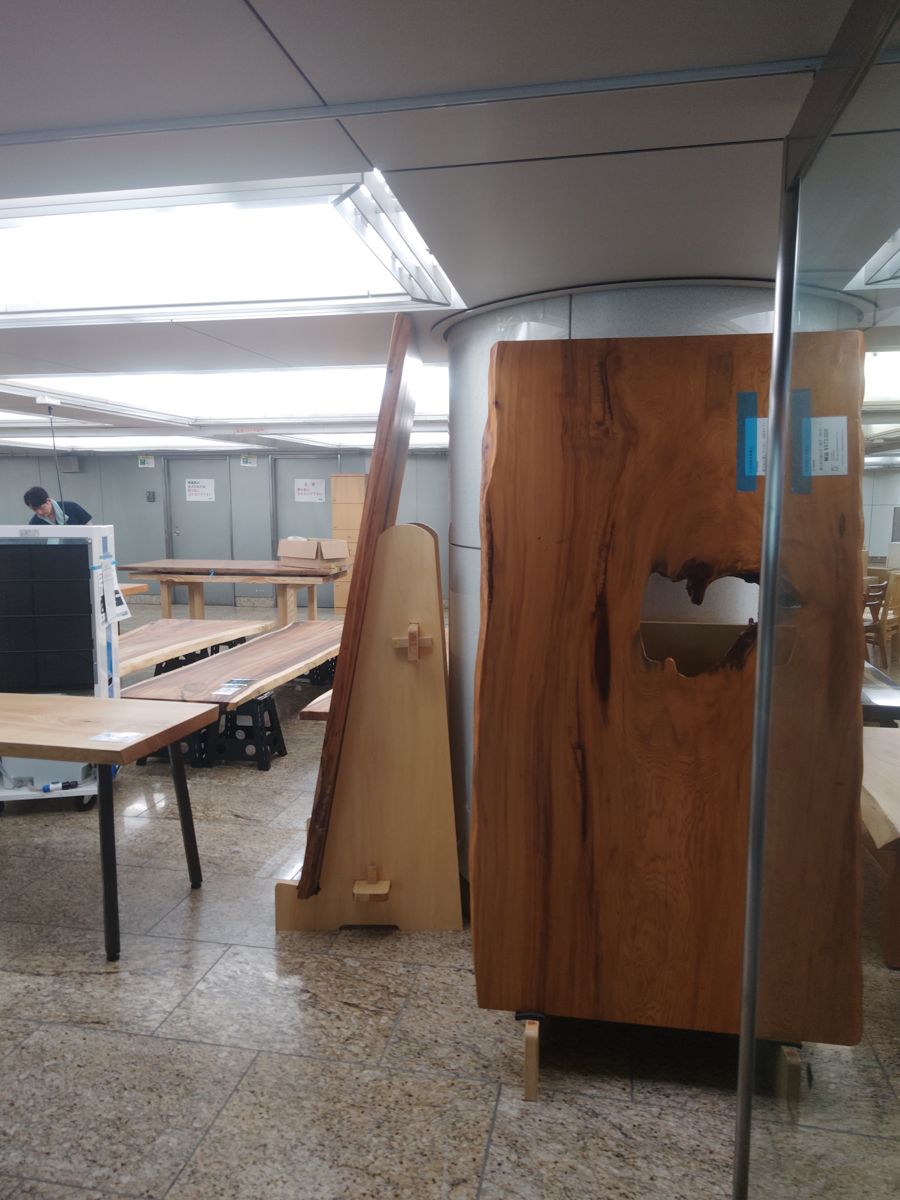
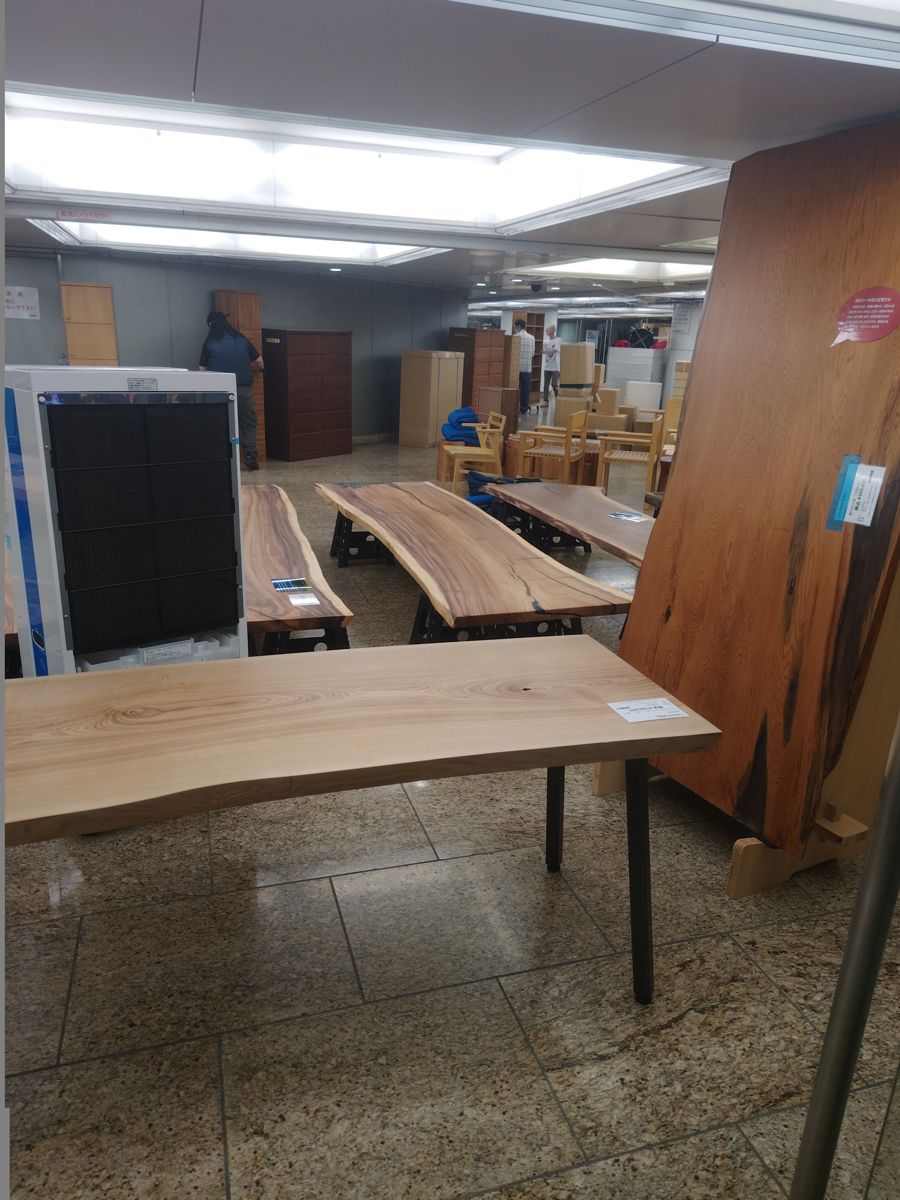
Single-piece slabs sawn from large trees remain popular. In July 2026, a slab sale was held in the event space beneath JR Shinjuku Station, with boards still bearing their bark-side edges (live edges) and boards with holes where knots had fallen out lined up as tabletops.
Contrecoller : le lamellé-collé et le CLT
Les bâtiments en bois d'aujourd'hui reposent sur des matériaux contrecollés. La charpente de toiture du Stade national utilise du bois lamellé-collé de mélèze et de cèdre du Japon, et les installations des athlètes du CLT national (panneaux de planches croisées).[3] Dans la préfecture de Nagano, une « poutre empilée collée » fabriquée à partir de petites et moyennes grumes de mélèze de moins de 30 cm de diamètre a reçu une homologation ministérielle.[4] Pouvoir transformer des arbres élancés en éléments structurels de grands bâtiments est ce qui a rendu possibles les bâtiments en bois du centre de Tokyo (chapitre 5).
Showing it off: furniture that makes use of cracks and rot
Cracks, rot holes and edges with bark left on are the parts usually cut away in ordinary sawmilling. Set in clear resin, they become furniture that shows those shapes as they are.
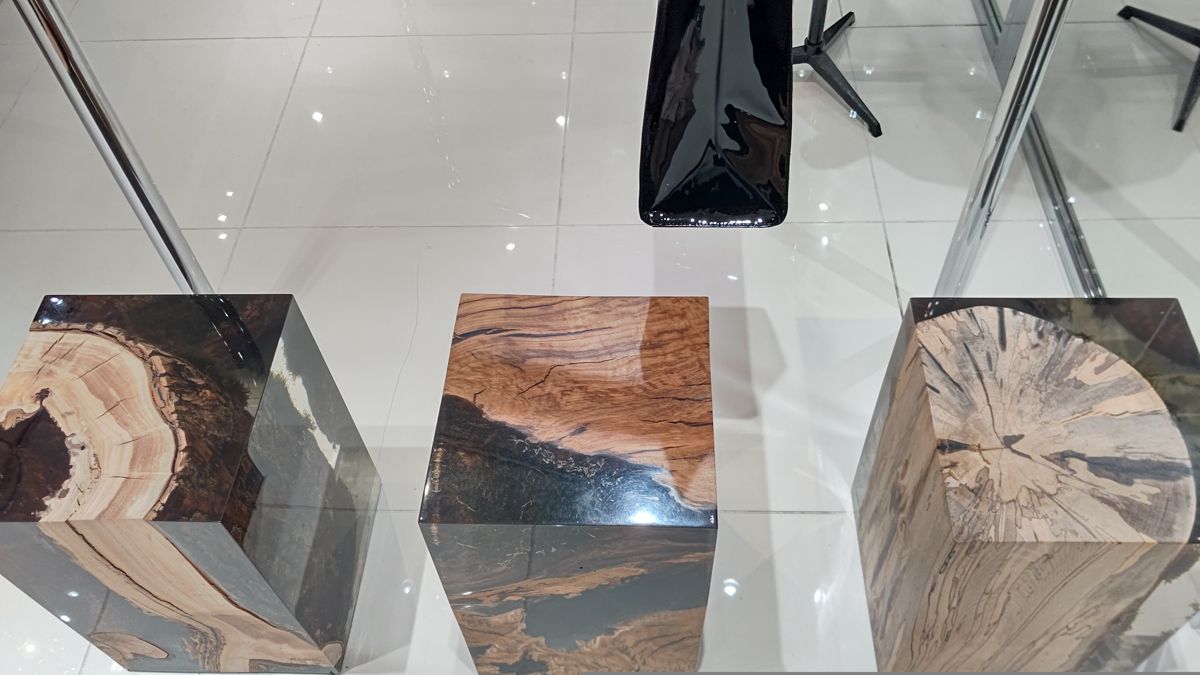
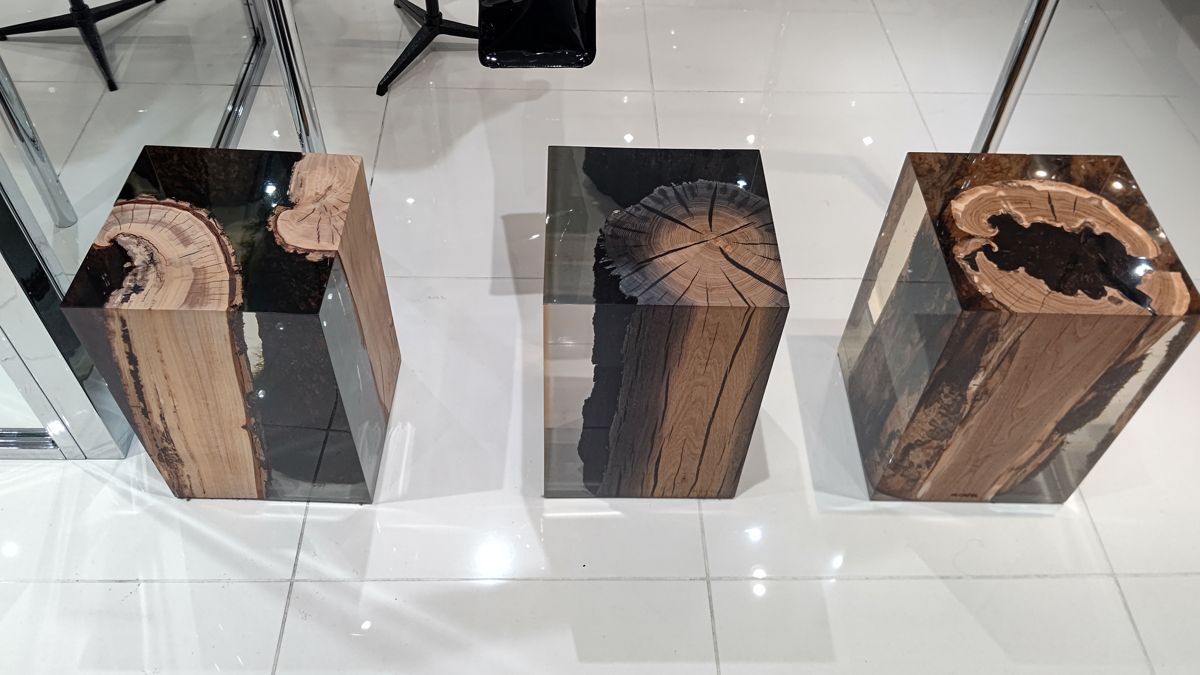
There were also solid-wood stools carved from blocks of log, without resin. The cracks running from the heart of the growth rings and the marks of the cutting tools are left as they are.
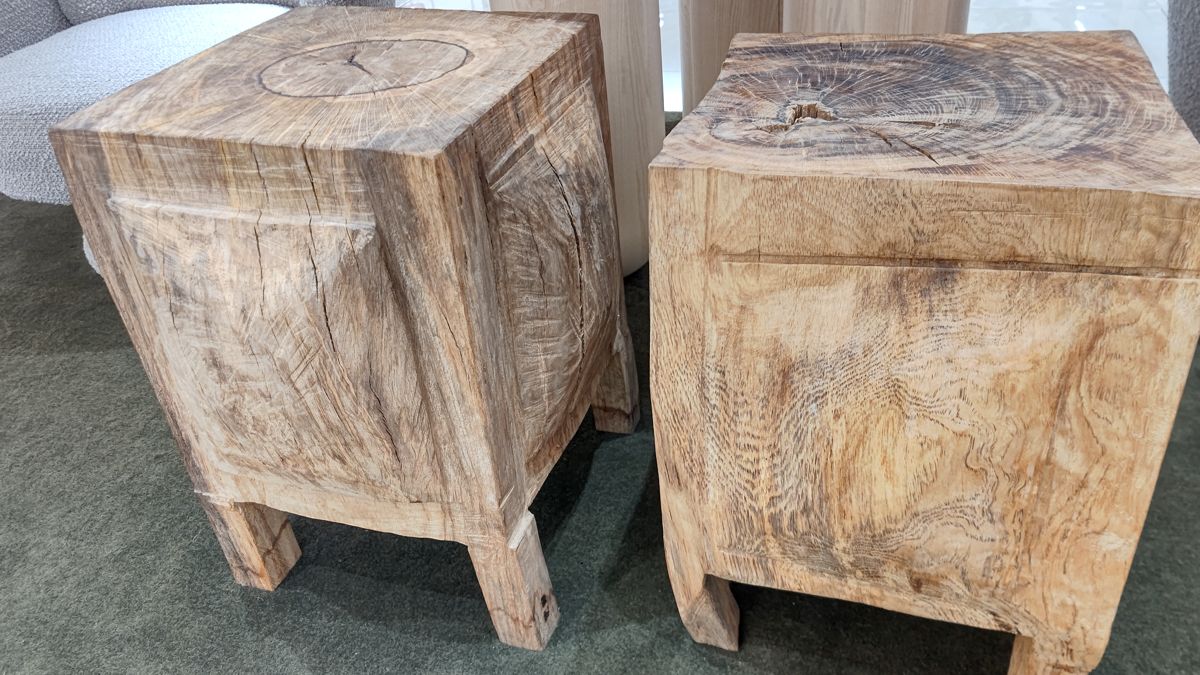
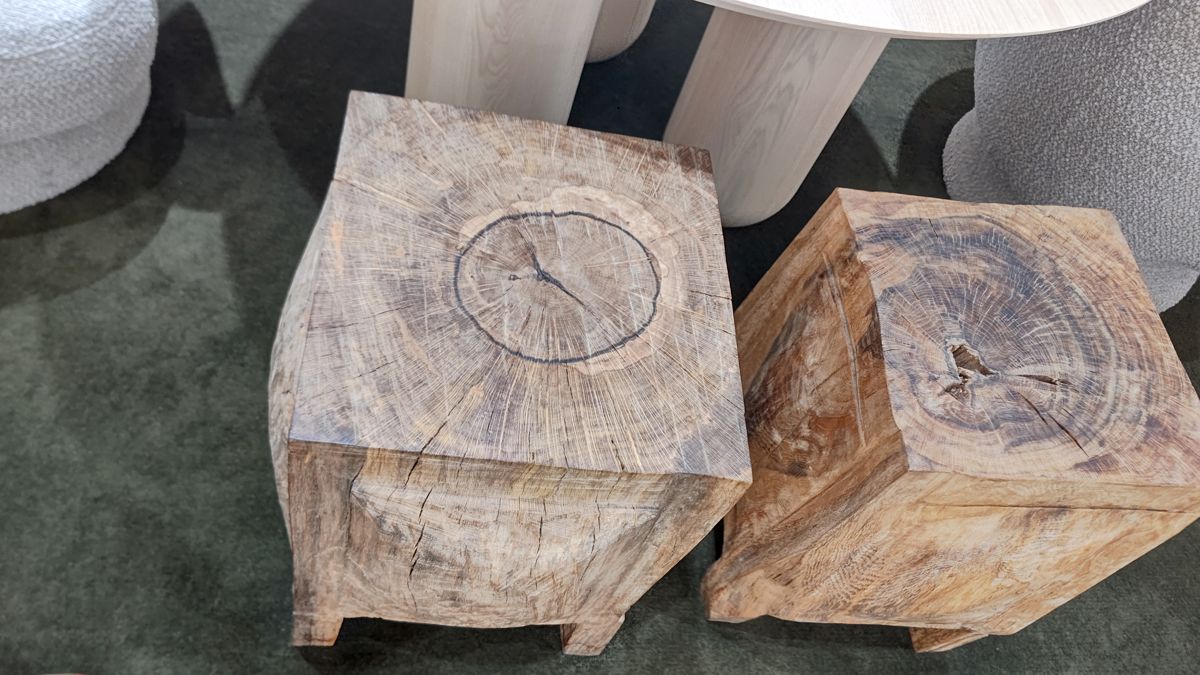
Even without making furniture, the shapes of branches and roots themselves can be put on show. In a clothing store in Shibuya, a huge tangle of dried branches and vines hung from the ceiling, spreading over the sales floor.

Split firewood, once stacked, becomes decoration in itself. In the lounge of the Conrad Tokyo in Shiodome, small conifer ornaments were lined up on a partition of firewood stacked like a wall.
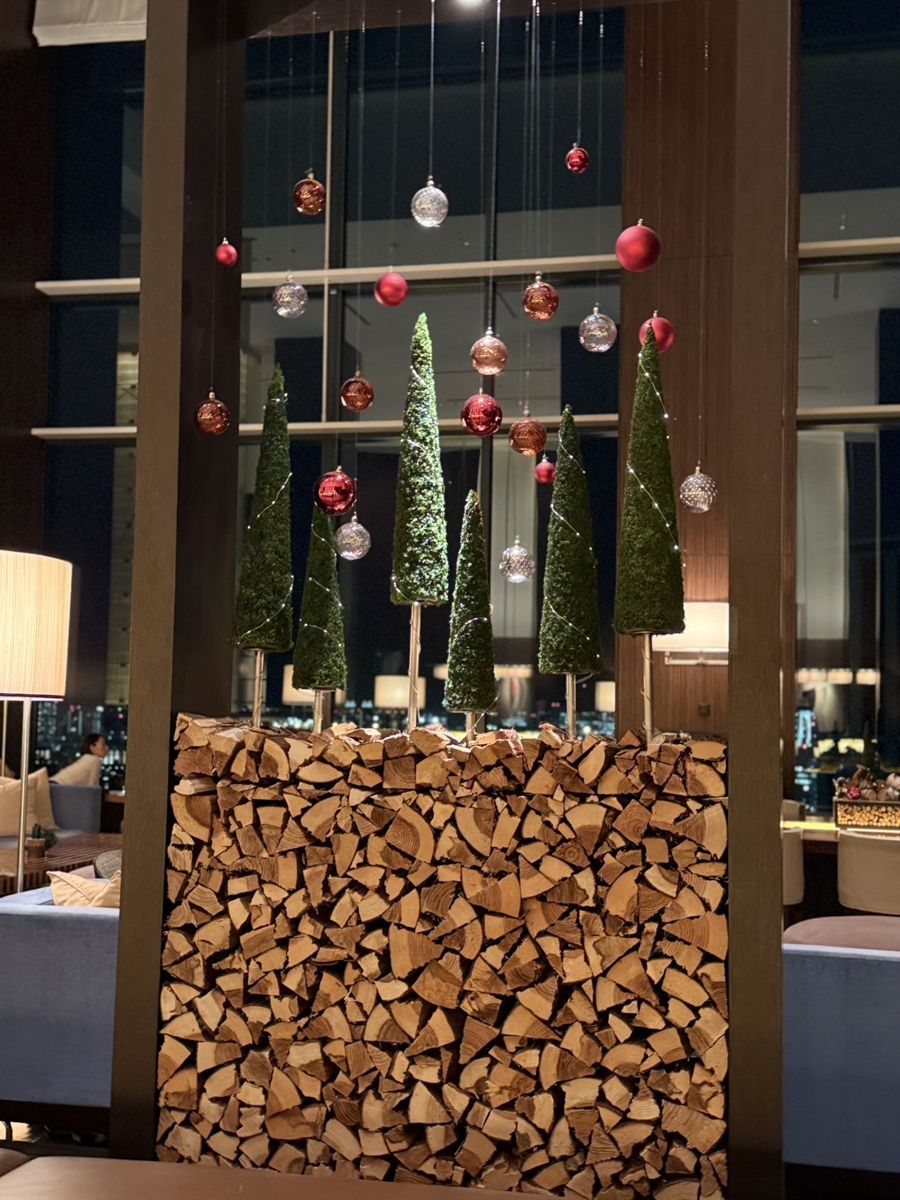
The resin blocks and solid-wood stools were photographed on the sales floor of a department store in Tokyo with the store's permission. I did not record what kinds of wood and resin were used.
Les fondations de la ville et le devenir des arbres abattus
Les poteaux électriques en bois
Les premiers poteaux du Japon furent dressés en 1869 pour porter une ligne télégraphique officielle entre le bureau du phare de Yokohama et le tribunal. Du début de l'ère Meiji à l'ère Taisho, les poteaux étaient en bois.[5]
Les poteaux en bois pourrissent à partir de l'endroit où ils touchent le sol. Une étude menée à Hokkaido décrit des poteaux traités sous pression à la créosote, principalement en épicéa d'Ezo et en sapin de Sakhaline, le mélèze étant utilisé pour les petits poteaux. Des poteaux dressés en 1958 avaient perdu leur produit de préservation 22 ans plus tard et étaient fortement dégradés, surtout au niveau du sol.[6] Le rapport, datant de 1981, note que les poteaux en béton étaient déjà courants en zone urbaine.[6]
Quand et comment les poteaux en bois de Tokyo ont été remplacés par du béton reste en cours de recherche. Les essences et le traitement ci-dessus sont des exemples de Hokkaido.
Le remblaiement de la baie de Tokyo
Une grande partie des terres de Tokyo a été créée en comblant la mer. Peu après son entrée à Edo, Tokugawa Ieyasu entreprit de combler l'anse de Hibiya, qui devint terre ferme entre 1593 et 1614. Il fit aussi araser la colline de Kanda et utilisa sa terre pour remblayer la zone allant de Nihonbashi-Hamacho à Shinbashi. Le centre du port d'Edo fut établi à Nihonbashi.[7]
À l'est de la Sumida, le remblaiement commença en 1596. Entre 1615 et 1629, les terres gagnées sur la mer se multiplièrent rapidement dans l'est de l'actuel arrondissement de Chuo, notamment à Reiganjima. Chaque parcelle était entourée de canaux et devenait un kashi, un débarcadère pour les bateaux.[7]
Le stockage du bois recoupe cette histoire du remblaiement. Le Kiba de l'ère Genroku fut construit par des grossistes en bois qui comblèrent eux-mêmes les marais de Fukagawa (chapitre 1). Shin-Kiba, où il fut transféré à l'ère Showa, se trouve lui aussi sur des terres gagnées sur la baie de Tokyo.
Wood inside the reclaimed land
Wood itself is buried inside the reclaimed land. In postwar Tokyo Port, the sea was filled with garbage, and from 1957 to 1967 garbage was brought to Landfill No. 14—later known as "Yumenoshima" (Dream Island). In a Tokyo Metropolitan Bureau of Port and Harbor survey, "wood, bamboo and straw" made up 13% of the garbage at No. 14.[8] The wood waste of the time was not burned but became part of the material that turned sea into land.
Wood that holds up soft ground: pine piles
On soft, waterlogged ground, wooden piles have long been driven beneath buildings to support them. Beneath the Marunouchi building of Tokyo Station, completed in 1914, about 10,000 pine piles were driven at 0.5 m intervals.[9] Wood rots when exposed to air, but below the groundwater table no oxygen reaches it, so it does not rot and keeps its form for a long time.[10]
Using logs for ground improvement today
Making use of this property, a liquefaction countermeasure that drives thinned logs into the ground has been developed. Logs of sugi, larch and the like—simply debarked and sharpened—are driven into sandy ground to compact it and prevent liquefaction in earthquakes.[11] Because logs placed below the groundwater table do not rot and keep storing carbon, the method is also described as "creating a new forest underground."[10] In a case introduced in a Forestry Agency competition, 570 m³ of thinnings were used.[11] The Tokyo Bay shore, with its many reclaimed areas, is also land at risk of liquefaction, so this is a possible use for Tama thinnings as well.
For "soil improvement" of the surface soil, chips and compost made from pruned branches of street and park trees are used (see "Green recycling" in the next section).
I have not confirmed any case of log-driving liquefaction countermeasures in Tokyo, or any use of Tama timber for them. Nor have I confirmed how Tokyo Station's pine piles were treated in the preservation work.
Le devenir du bois abattu
Tama est connue de longue date comme le « district forestier d'Ome », produisant principalement des poteaux et des perches d'échafaudage.[12] Aujourd'hui, outre le bois de construction, son bois sert aussi au contreplaqué (chapitre 7) et au combustible. Nous examinons ici séparément le bois coupé en montagne et le bois coupé en ville.
Le bois de montagne comme combustible : le village de Hinohara
Le village de Hinohara continue de transformer son propre bois en chaleur.[13][14]
| Année | Installation | Détails |
|---|---|---|
| 2012 | Centre thermal Kazuma no Yu | Deux chaudières à bûches de 80 kW installées à côté des chaudières au kérosène ; la totalité des quelque 70 t de bois de chauffage consommées chaque année provient du village[13] |
| 2012 | Production de bois de chauffage | Un système de collecte du bois et de fabrication de bois de chauffage a créé des emplois par l'intermédiaire du Centre des ressources humaines seniors ; le bois de chauffage est vendu empilé sur des palettes[14] |
| 2017 | Établissement social Yasuragi no Sato | Une chaudière à plaquettes a remplacé les combustibles fossiles[14] |
Le village subventionne l'abattage et le débardage afin que le bois d'éclaircie, auparavant laissé sur place en montagne, puisse être sorti.[14] Utiliser le bois comme combustible permet de valoriser même les parties minces et tordues des arbres abattus.
Rendre les arbres de la ville à la ville : le recyclage des déchets verts
Les branches et les feuilles issues de l'élagage des arbres des parcs et d'alignement peuvent aussi être utilisées. Depuis l'exercice 1990, l'arrondissement de Koto rend à ses propres espaces verts les branches et les feuilles mortes de sa végétation au lieu de les brûler ou de les enfouir.[15]
| Forme | Usage |
|---|---|
| Plaquettes | Revêtement amortissant des allées de parc, paillage des massifs[15] |
| Compost | Distribué lors des manifestations de l'arrondissement ; amendement des sols des parcs et des écoles[15] |
| Bois | Plaques nominatives d'arbres ; matériau de bricolage pour les écoles et les jardins d'enfants[15] |
Tokyo compte plus d'un million d'arbres d'alignement (chapitre 8). Comment valoriser leurs résidus d'élagage relève d'une sorte de défi de « foresterie urbaine ».
Laid on park paths: wooden paving of Tama timber
Tama wood is also used underfoot in metropolitan parks. According to a sign by the Tokyo Metropolitan Eastern Park Office that I saw in Ueno Park, the Tokyo government has used Tama timber, including thinnings, for road guard fences, the "Memorial Benches" in metropolitan parks and more, to conserve Tama's deteriorating forests and help prevent global warming. The sign explains that wooden paving will eventually rot and need replacing, but that this keeps thinnings in use and so helps protect the Tama forests.
It is a way of counting rot not as a defect but as a reason to keep using wood. The sign does not say, however, how much wood went into the paving, or whether Tama timber is used again each time it is replaced.
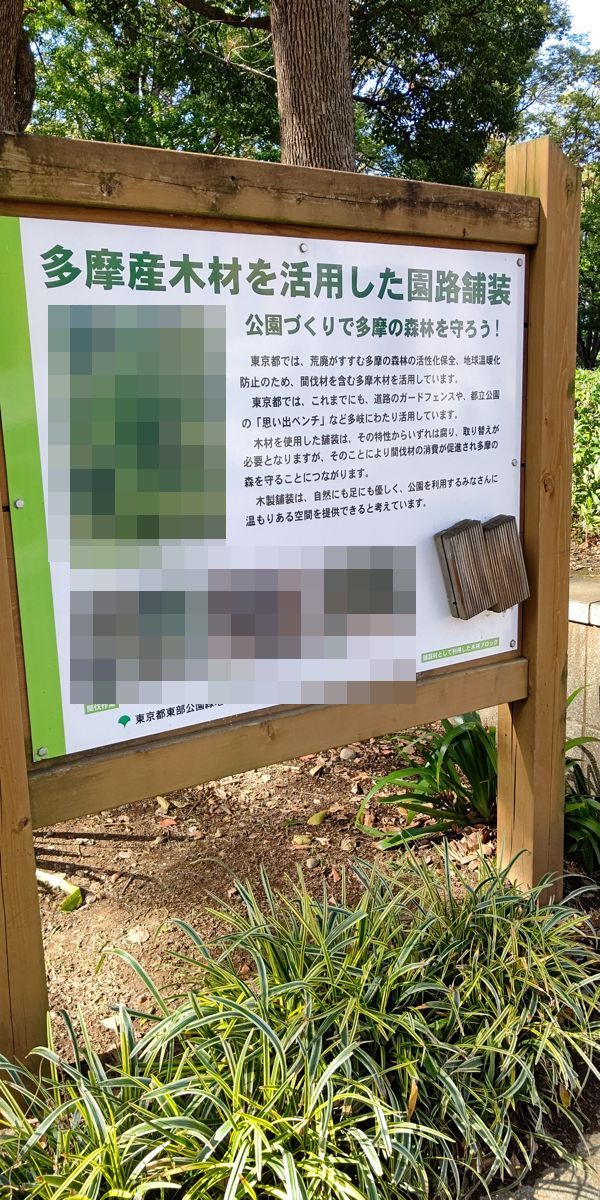
The sign's content is as of October 2021, when the photo was taken. I have not checked the current state of the paving.
Wood crossing the prefectural border: the Otsuki biomass power plant
Felled wood is sometimes carried out of Tokyo. The Otsuki Biomass Power Plant in Otsuki, Yamanashi, has an output of about 14,500 kW, enough electricity for about 30,000 households. It burns about 150,000 tonnes a year of chips made from unused thinnings and pruned branches, mainly from Yamanashi and the wider Kanto region.[16] It began commercial operation in summer 2018.[17]
When the author saw it from a train window in October 2020, logs were piled high in the plant's yard. They were "obstructing trees" (trees felled because they stand in the way of construction) from the building of the Shin-Tomei Expressway (the Second Tomei). Trees cut to build a road were being turned into electricity.
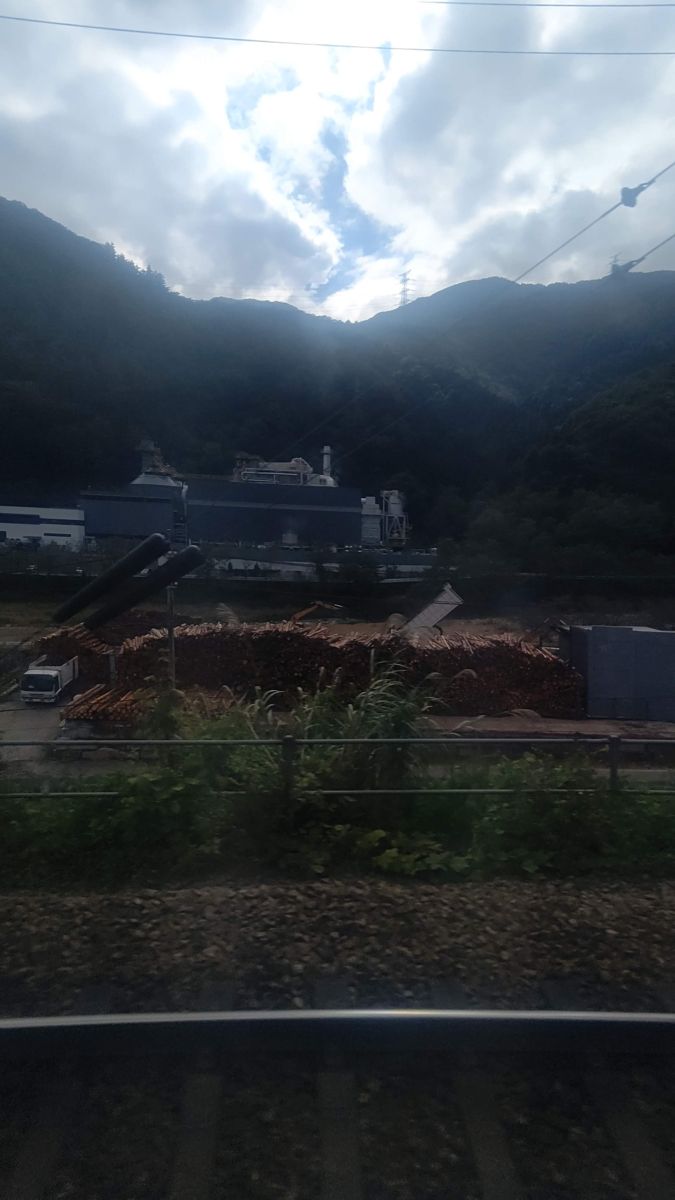
The acceptance of obstructing trees is based on what the author saw and heard on site; it has not been checked against materials from the power plant or the expressway company.
Wood stove smoke: US regulation and Japan
Wood stoves, which burn felled wood as fuel, are being reconsidered as a use for wood. But burning makes smoke, and how countries deal with the fine particles (PM2.5) in that smoke differs greatly.
In the United States, standards under the Clean Air Act set limits on particle emissions from new residential wood stoves offered for sale. The 2015 standard was 4.5 g per hour; from May 2020 it became stricter, at 2.0 or 2.5 g per hour depending on the test method. Stoves that do not meet the standard cannot be sold new.[18] There are also local rules. In the San Francisco Bay Area, burning wood in fireplaces, wood stoves, pellet stoves or outdoor fire pits is illegal on days when a winter air-pollution alert is issued, with fines of $100 for a first violation and $500 for a second.[19] "Changeout" programs that subsidize replacing old stoves with certified ones are also run in many areas. The EPA explains that just 20 old non-certified stoves can emit more than a ton of fine particles during the cold months.[20]
In Japan, there is no law or ordinance regulating smoke or odor from household wood stoves. Neighbor complaints about smoke are treated as civil matters that local governments say they cannot handle. All they can do is "ask" users to burn well-dried wood, not to burn garbage or construction waste, to be considerate of the time of day and surroundings, and to clean their chimneys.[21] With no emission standard for products either, which stove to choose and how to burn it is left to the user.
| United States | Japan | |
|---|---|---|
| Emission standard for new stoves | Yes (2.0–2.5 g/h from 2020)[18] | None |
| Ban on high-pollution days | Depends on area (e.g., Bay Area bans burning on alert days, with fines)[19] | None |
| Neighbor smoke complaints | May be enforced under local rules | A civil matter; local governments can only make requests[21] |
If you use a wood stove in densely built Tokyo, the lack of a Japanese standard does not mean anything goes. How much smoke you produce depends greatly on whether your firewood is well dried and whether your stove burns as cleanly as the US standard requires.
I have not confirmed guidance on wood stoves issued by the Tokyo Metropolitan Government or Tokyo's municipalities, or the number of complaints in Tokyo.
Sources
- 東京都 木育関連リーフレット(令和5年度) PDF
- コトバンク「大鋸」 Lien
- 日本スポーツ振興センター「国立競技場について」 PDF
- 長野県林業総合センター 研究トピックス(接着重ね梁) PDF
- 国土交通省 無電柱化に関する資料 PDF
- 北海道立林産試験場『林産試月報』1981年4月号(クレオソート油処理木柱) PDF
- 国土交通省 関東地方整備局 東京港湾事務所「江戸の港」(原典:鈴木理生『江戸の川・東京の川』ほか) PDF
- 東京都港湾局「東京港のごみ埋立地盤の安定化調査について」(平成13年5月) PDF
- 日立製作所「東京駅丸の内駅舎」(日立の技術誌Foresight) PDF
- 日本建設機械施工協会『建設機械施工』Vol.66 No.5「新工法紹介 丸太打設液状化対策工法」(2014年5月) PDF
- 林野庁「Forest Good 2015 間伐・間伐材利用コンクール」(丸太打設液状化対策&カーボンストック工法) PDF
- 東京都「林業・木材産業循環成長対策 変更事業構想」 PDF
- 林野庁『平成28年度 森林・林業白書』事例(檜原村 数馬の湯) Lien
- 環境情報センター(EIC)「首長に聞く」檜原村 Lien
- 江東区「緑のリサイクル」 Lien
- 大林組 ニュースリリース「大月バイオマス発電所の建設に着手」(2016年8月4日) Lien
- 大林組 ニュースリリース(2018年6月1日、大月バイオマス発電所の営業運転開始) Lien
- 米国環境保護庁(EPA)「EPA Certified Wood Stoves」 Lien
- ベイエリア大気質管理地区(BAAQMD)「Winter Spare the Air」(2024年11月30日) Lien
- EPA「Implementing Wood-Burning Changeout Campaigns and Examples of Programs」 Lien
- 柏市「家庭用薪ストーブの使用」(2026年1月16日更新) Lien