परिचय / अध्याय 2
तामा की वानिकी
टोक्यो के लगभग 70% जंगल महानगर के पश्चिमी भाग, तामा क्षेत्र में हैं। इनका क्षेत्रफल लगभग 53,000 हेक्टेयर है।[1] तामा के निजी जंगलों में 60% सुगी, हिनोकी आदि के रोपित जंगल हैं, जिनमें से अधिकांश शोवा 30 से 40 के दशक (लगभग 1955–1974) में लगाए गए थे।[1]
तामा के वन आज
पेड़ लगाने का दौर, और पेड़ न लगाने का दौर
वृक्षारोपण शोवा 35 (1960) में प्रति वर्ष 1,500 हेक्टेयर से अधिक हो गया था। उसके बाद इसमें तेज़ गिरावट आई और हेइसेई 15 (2003) में यह केवल 6 हेक्टेयर रह गया।[1] आयु-वर्ग के हिसाब से देखें तो पहाड़ों पर एक ही पीढ़ी के पेड़ खड़े हैं और युवा जंगल लगभग नहीं हैं।
| वित्त वर्ष | नया रोपित क्षेत्रफल | स्थिति |
|---|---|---|
| शोवा 35 (1960) | 1,500 ha से अधिक | विस्तार-वृक्षारोपण का चरम |
| हेइसेई 15 (2003) | 6 ha | सबसे कम का दौर |
| रेइवा 4 वित्त वर्ष (2022) | 48 ha | काटकर फिर से लगाने का कार्यक्रम जारी |
स्रोत: टोक्यो महानगर सरकार, वानिकी और लकड़ी उद्योग की चक्रीय वृद्धि हेतु उपाय: संशोधित परियोजना योजना[1]
पेड़ क्यों नहीं काटे जाते
लकड़ी की कीमतों में लंबी मंदी और मज़दूरी की बढ़ती लागत से वानिकी घाटे का सौदा बन गई, और उपयोग लायक मोटाई तक बढ़ चुकी 50 वर्ष से अधिक पुरानी सुगी और हिनोकी की कटाई रुक गई।[3] इसके साथ ही खड़ी ढलानों के कारण काम का ख़र्च अधिक होना, और टोक्यो के वानिकी व्यवसायों का छोटा आकार व कम मुनाफ़ा भी कारण हैं।[1]
परागकण के रूप में शहर तक पहुँचना
बिना कटी सुगी शहरी जीवन को भी प्रभावित करती है। हेइसेई 29 (2017) के सर्वेक्षण में टोक्यो में सुगी-परागकण एलर्जी (हे फ़ीवर) की व्यापकता अनुमानित 48.8% थी, जबकि हेइसेई 18 वित्त वर्ष (2006) के सर्वेक्षण में यह 28.2% थी।[3] टोक्यो कृषि, वानिकी और मत्स्य संवर्धन फ़ाउंडेशन सुगी को काटकर कम परागकण वाली किस्में लगाने का कार्यक्रम चला रहा है। हेइसेई 18 वित्त वर्ष (2006) से रेइवा 2 वित्त वर्ष (2020) तक इस कार्यक्रम से कुल 2,57,000 घन मीटर लकड़ी भेजी गई।[3]
प्राकृतिक जंगल और राष्ट्रीय जंगल
हाचिओजी शहर के ताकाओ पर्वत राष्ट्रीय वन में मोमी (जापानी फ़र) के प्राकृतिक जंगल को संरक्षित वनस्पति-समुदाय वन घोषित किया गया है। यह क्षेत्र शीत-शीतोष्ण और उष्ण-शीतोष्ण क्षेत्रों की सीमा पर है, और यहाँ के प्राकृतिक जंगलों में इनुबुना (जापानी ब्लू बीच), कोनारा, मोमी, त्सुगा (हेमलॉक) आदि मिलते हैं।[4]
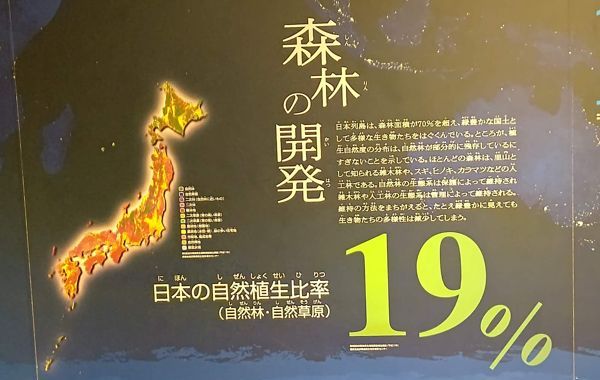
Across Japan as a whole, vegetation left in its natural state is not common. An exhibit panel I saw at a museum in Ueno Park showed that while forests cover more than 70% of Japan, most of them are satoyama coppice woodland or plantations of sugi, hinoki, larch and the like, and that "natural vegetation"—natural forest and natural grassland combined—makes up 19%. The panel cites the Ministry of the Environment's National Survey on the Natural Environment as its source.
Protection forests: woods you cannot fell freely
Protection forests (hoan-rin) are forests whose public functions, such as storing water, preventing landslides or breaking the wind, are especially important. Under the Forest Act, the Minister of Agriculture, Forestry and Fisheries or a prefectural governor designates them. There are 17 types by purpose, including water-source conservation and erosion control. Once designated, felling trees and changing the shape of the land are regulated[5]. At the end of FY2023 Japan had 12.29 million ha of protection forest: 49.1% of its forests and 32.5% of its land area[6].
The system goes back to the Meiji era. After the great floods of 1896, the Forest Act was enacted in 1897. After the war, the Temporary Measures Act for Protection Forest Improvement of 1954 drove designations forward, renewed every ten years[7].
| Restrictions after designation | Benefits in return |
|---|---|
| Felling requires a permit or notification | Exempt from fixed property tax, real estate acquisition tax and special land holding tax |
| No conversion to other uses such as housing | For inheritance and gift tax, the valuation is reduced by 30–80% depending on how strict the felling limits are |
| Changing the land, for example building work roads, requires a permit | |
| Felled areas must in principle be replanted |
Source: Saitama Prefecture, "About protection forests"[8]. The system rests on the nationwide Forest Act.
In Tokyo, the area of the Tokyo Metropolitan Forestry Office, covering 15 Tama municipalities, held 14,838 ha of protection forest as of 31 March 2019. Of this, 12,478 ha, about 84%, is water-source conservation forest. National forest accounts for 935 ha and non-national forest for 13,903 ha[9].
| प्रकार | राष्ट्रीय जंगल | Non-national forest | कुल |
|---|---|---|---|
| Water-source conservation | 485 | 11,993 | 12,478 |
| Erosion control | 296 | 1,316 | 1,612 |
| Landslide prevention | 0 | 51 | 51 |
| Windbreak | 0 | 1 | 1 |
| Drought prevention | 0 | 7 | 7 |
| Rockfall prevention | 0 | 35 | 35 |
| Public health (recreation) | 154 | 429 | 583 |
| Scenic | 0 | 71 | 71 |
| Total | 935 | 13,903 | 14,838 |
Unit: ha. As of 31 March 2019. A further 10 ha of non-national fire-prevention forest and 2,293 ha of forest designated for two purposes at once are excluded from the totals. Source: Tokyo Metropolitan Forestry Office, "Business overview, 2019 edition"[9].
Forests in the same area total 52,867 ha (as of 1 April 2019), so protection forest is about 28% of the forest[9]. That is lower than the national 49.1%, but the dates and scope differ, so treat it as a rough comparison.
In FY2018 the Forestry Office handled 9 felling permits (30.4 ha), 37 work permits and 92 thinning notifications (112.8 ha). Inquiries about whether a given plot lies in protection forest numbered 379, covering 4,023 parcels[9]. The metropolitan government manages 10 metro-owned public-health protection forests, 239.4 ha in all, in Hachioji, Akiruno and Hinohara[9].
The water-source forests managed by the Tokyo Waterworks Bureau are also protection forest. They cover 25,666 ha across Okutama and, in Yamanashi, Koshu, Tabayama and Kosuge; Tokyo Prefecture took them over from the imperial forests and began managing them in 1901. They are designated as water-source conservation, erosion control and public-health protection forest[10]. The Yamanashi part is not in the Tama table above.
The Tokyo figures come from the 2019 business overview; the latest areas have not been confirmed. Protection forests on the islands and in the 23 wards have not been researched here.
वानिकी में काम करने वाले लोग और पैसा
वानिकी कामगार: देशभर में 44,000
जापान में वानिकी में काम करने वाले लोगों (वानिकी कामगारों) की संख्या लंबे समय से घटती रही है और 2020 में लगभग 44,000 रह गई। 65 वर्ष और उससे अधिक आयु वालों का अनुपात (वृद्धता दर) 25% है, जो सभी उद्योगों के 15% से अधिक है। दूसरी ओर, 35 वर्ष से कम आयु वालों का अनुपात (युवा दर) 1990 के बाद से बढ़ा है और अब 17% है।[11]
सरकार का “Green Employment” कार्यक्रम शुरू होने से पहले हर साल औसतन लगभग 2,000 लोग वानिकी में आते थे, शुरू होने के बाद यह संख्या बढ़कर लगभग 3,200 प्रति वर्ष हो गई।[11] कार्यस्थल पर प्रशिक्षण लेते हुए काम शुरू करने की व्यवस्था नए लोगों की संख्या बढ़ा रही है।
टोक्यो में वानिकी का कार्यक्षेत्र
टोक्यो महानगर सरकार द्वारा शहर की वानिकी संस्थाओं के सर्वेक्षण की रिपोर्ट (54 संस्थाओं ने उत्तर दिया) के अनुसार, कार्यस्थल पर काम करने वालों की औसत आयु 45.7 वर्ष है और 34 वर्ष या उससे कम आयु वालों का अनुपात लगभग 27% है। वित्त वर्ष 2024 में 21 लोग नए आए और 19 ने काम छोड़ा; एक वर्ष की टिकाव दर 91.8% है। 15 वर्ष या उससे कम अनुभव वाले लोग 57.3% हैं।[12]
सबसे आम वेतन “40 लाख से 45 लाख येन से कम” है (26.2%), और लगभग 46% को 40 लाख येन से कम मिलता है। सर्वेक्षित संस्थाओं में से लगभग तीन-चौथाई ने पिछले वर्ष की तुलना में वेतन बढ़ाया है।[12]
जोखिम और कार्य-परिस्थितियाँ
वानिकी आज भी बहुत जोखिम भरा काम है। प्रति 1,000 कामगार एक वर्ष में मृतकों और घायलों की संख्या (प्रति हज़ार दुर्घटना दर) 2022 में वानिकी में 23.5 और सभी उद्योगों में 2.3 थी, यानी लगभग 10 गुना। औसत वार्षिक वेतन वानिकी में 36.1 लाख येन और सभी उद्योगों में 45.8 लाख येन था।[13]
काम करने का तरीका बदल रहा है। साल में 210 दिन या उससे अधिक काम करने वालों का अनुपात वित्त वर्ष 1985 के 9% से बढ़कर लगभग 70% हो गया, और मासिक वेतन पाने वालों का अनुपात 2% से बढ़कर लगभग 30% हो गया।[13] रोज़गार पूरे साल काम करने वाले स्थिर रूप के करीब आ रहा है।
मशीनीकरण: उच्च-क्षमता वानिकी मशीनें
पेड़ काटना, शाखाएँ छाँटना, तय लंबाई में काटना, बाहर ढोना — जो काम पहले हाथों, चेनसॉ और तार-रस्सी से होते थे, अब विशेष मशीनें करने लगी हैं। वित्त वर्ष 2024 में जापान में 16,431 उच्च-क्षमता वानिकी मशीनें थीं, जो पिछले वर्ष से 1,365 अधिक हैं — और दस साल पहले (वित्त वर्ष 2014) की 7,089 का लगभग 2.3 गुना।[14]
| मशीन | काम | संख्या (वित्त वर्ष 2024) |
|---|---|---|
| फॉरवर्डर | कटे हुए लट्ठों को अपने डाले में लादकर बाहर ले जाता है | 5,186[14] |
| प्रोसेसर | गिराए गए पेड़ों की शाखाएँ छाँटता है और उन्हें तय लंबाई में काटता है | 2,348[14] |
| हार्वेस्टर | खड़े पेड़ों को काटकर गिराता है और शाखा-छँटाई व टुकड़ों में कटाई भी करता है | 2,272[14] |
| स्विंग यार्डर | तार-रस्सी से ढलान के नीचे या ऊपर से लट्ठों को खींच लाता है | 1,151[14] |
मशीनों के काम का विवरण सामान्य है। संख्याएँ पूरे जापान का योग हैं; टोक्यो की संख्या की पुष्टि नहीं हुई है।
क्या वानिकी लाभदायक है?
वानिकी एजेंसी के अनुमान के अनुसार, 50 वर्ष पुराने सुगी (जापानी देवदार) रोपित वन के 1 हेक्टेयर को काटने पर लट्ठों की बिक्री से 39.8 लाख येन मिलते हैं। लेकिन कटाई और ढुलाई का खर्च घटाने के बाद वन-मालिक का हिस्सा (खड़े पेड़ की कीमत) केवल 13.7 लाख येन रह जाता है। उसके बाद पौधे लगाने और देखभाल शुरू करने का खर्च 27.5 लाख येन आता है, जो इस हिस्से से अधिक है। सिर्फ़ काटने और दोबारा लगाने से ही घाटा हो जाता है।[15]
वानिकी एजेंसी का अनुमान है कि मशीनीकरण और रोपण में श्रम-बचत को मिलाने वाली “नई वानिकी” से आज संभव उपायों के साथ 7.1 लाख येन और नई तकनीक अपनाने पर 11.3 लाख येन का लाभ हो सकता है।[15] वन-मालिक का हिस्सा पहले की तुलना में कितना घटा है, यह परिशिष्ट के “पुराने समय में लकड़ी की कीमत” में दिया गया है।
प्रति हेक्टेयर राशियाँ वानिकी एजेंसी के राष्ट्रीय अनुमान से हैं; ये केवल टोक्यो के वनों के आँकड़े नहीं हैं।
नए कामगार कैसे जुटाएँ
नए कामगार जुटाने के मुख्य आधार हैं — सरकार के “Green Employment” जैसे प्रशिक्षण-सहित रोज़गार सहायता, और वेतन व साल भर के रोज़गार जैसी कार्य-परिस्थितियों में सुधार।[11][13] टोक्यो में अधिकांश संस्थाओं ने वेतन बढ़ाया है, और नए आने वालों और छोड़ने वालों की संख्या लगभग बराबर है।[12] टोक्यो में वानिकी का काम पाने की जानकारी और स्वयंसेवक के रूप में वनों की देखभाल में भाग लेने के संपर्क परिशिष्ट की लिंक-सूची में दिए गए हैं।
Forests, wood and taxes
Forest environment tax: ¥1,000 a year from Tokyo residents too
Taxes are also used to care for forests. Since fiscal 2024, a "forest environment tax" of ¥1,000 a year has been collected from each person who pays resident tax. Some 60 million people pay it, and revenue is expected to be about ¥60 billion a year.[16]
The tax is distributed to municipalities and prefectures as the "forest environment transfer tax," which began ahead of it in fiscal 2019. It is allocated by three criteria: the area of privately owned planted forest, the number of forestry workers, and population. Criticism that the large population weight sends much of it to urban areas with few forests led to a revision from fiscal 2024 to 55% planted forest area, 20% forestry workers and 25% population.[16]
| Allocation criterion | Until FY2023 | From FY2024 |
|---|---|---|
| Private planted forest area | 50% | 55% |
| Forestry workers | 20% | 20% |
| Population | 30% | 25% |
Source: Dai-ichi Life Research Institute (December 6, 2024)[16]
Even the 23 wards, which have almost no forest, receive this transfer tax. They can spend it either on using wood within their own ward or on helping regions that have forests. In fiscal 2023, for example, Suginami Ward used it for school rebuilding, chairs and shelves for childcare facilities and repairs to wooden playground equipment in parks, as well as a carbon offset project in partnership with another municipality and thinning experiences for children.[17]
Rules for using wood in public buildings
In 2010 the national government enacted the Act on Promotion of Use of Wood in Public Buildings, setting a policy of using wood in national and local government buildings. A revision in October 2021 renamed it the Act on Promotion of Use of Wood in Buildings to Contribute to Realizing a Decarbonized Society, and extended it to all buildings, including private ones.[18] The share of public buildings built of wood, 8.3% when the law was enacted, reached 15.9% in fiscal 2024; for low-rise public buildings of three stories or fewer it was 33.4%.[19] That also means more than half are still not built of wood.
Subsidies for using local wood: Tokyo Metropolis and Minato Ward
Through its "Tama Timber Use Promotion Project," the Tokyo Metropolitan Government subsidizes facilities that wards, cities, towns and villages build or improve using Tama timber—timber construction, wood interiors, wooden playground equipment, and wooden furniture and exterior structures. The subsidy covers half the cost, up to ¥30 million per municipality (as of the fiscal 2023 revision).[20]
There are also systems in which a ward requires the use of wood. Minato Ward's "Minato Model CO2 Fixation Certification System" asks developers building structures of 5,000 m² or more of total floor area in the ward to use 0.001 m³ of domestic timber per square meter of floor area. It also encourages the use of wood from regional municipalities that have signed agreements with the ward ("agreement timber"). It began in October 2011.[21] It is a mechanism by which a central-city ward with no forests channels money to regional forests through its buildings.
I have not confirmed the latest conditions of the Tokyo subsidy, the amounts of the forest environment transfer tax distributed to the 23 wards as a whole or to Tokyo and the Tama municipalities, or the wood-construction rate of public buildings in Tokyo.
स्रोत
- 東京都産業労働局「林業・木材産業循環成長対策 変更事業構想」 PDF
- 東京都「森づくり推進プラン」表1-1(原典:令和2年版 東京の森林・林業) PDF
- 公益財団法人東京都農林水産振興財団 説明資料 PDF
- 林野庁関東森林管理局「多摩森林計画区の概要」 PDF
- 林野庁「保安林制度」(水源林の保全) लिंक
- 林野庁「令和6年度 森林・林業白書」第1部第3章第1節 लिंक
- 林野庁 資料「保安林制度の沿革」 लिंक
- 埼玉県「保安林について」 लिंक
- 東京都森林事務所「事業概要 令和元年版」 लिंक
- 林野庁「水源の森百選 東京都水道水源林」 लिंक
- 林野庁「林業労働力の動向」 लिंक
- 東京都森林事務所『林業関係労働力実態分析報告書』(令和7年度、令和8年3月) PDF
- 林野庁「一目でわかる林業労働(データ編)」 PDF
- 林野庁「高性能林業機械の保有状況」 लिंक
- 林野庁『令和5年度 森林・林業白書』第2章(林業経営の効率化) लिंक
- 第一生命経済研究所「6,000万人が納税する森林環境税」(2024年12月6日) लिंक
- 杉並区「森林環境譲与税の使途」(令和5年度決算) PDF
- 林野庁「公共建築物等木材利用促進法」 लिंक
- 林野庁「公共建築物の木造率について」(令和8年3月30日更新) लिंक
- 東京都産業労働局「公共施設における多摩産材使用事例集 ver.6」 PDF
- 港区「みなとモデル二酸化炭素固定認証制度実施要綱」 PDF