Введение / Глава 6
Обработка и строительство
Бревна нельзя использовать как есть. Их нужно расколоть, распилить или склеить. Эта глава прослеживает, как обрабатывали древесину с периода Эдо до наших дней и как её использовали в строительстве — для опор ЛЭП и засыпки территорий.
Обработка древесины
Раскалывание: старше пилы
Криптомерия растёт прямо и легко раскалывается вдоль волокон. Её можно расколоть до толщины около 5 мм, и её использовали для бочек и кадок.[1] Старые японские пилы были поперечными и плохо подходили для продольной распиловки.[2] Поэтому легко раскалывающаяся древесина так ценилась.
Распиловка: ога и маэбики-ога
Ога — пила для продольной распиловки — пришла из Китая в XIV–XV веках (середина периода Муромати). Её полотно длиной около 2 м и шириной 5 см натягивалось в раме, и работали ею двое.[2] Она позволила легко выпиливать широкие тонкие доски, преобразив изготовление досок и деревообработку.[2]
В начале периода Эдо появилась и распространилась одноручная маэбики-ога.[2] Мастеров, распиливавших бревна на доски и брус, называли кобики — пильщиками.
| Метод | Период | Назначение |
|---|---|---|
| Раскалывание | С древних времён | Продольное раскалывание прямых бревен; клёпка для бочек и кадок[1] |
| Ога (двуручная) | Появилась в XIV–XV вв. | Продольная распиловка широких тонких досок[2] |
| Маэбики-ога (одноручная) | Распространилась в начале Эдо | Пильщик распиливает в одиночку[2] |
| Клееный брус / CLT | Сегодня | Мелкие заготовки склеивают в крупные колонны, балки и стены[3] |
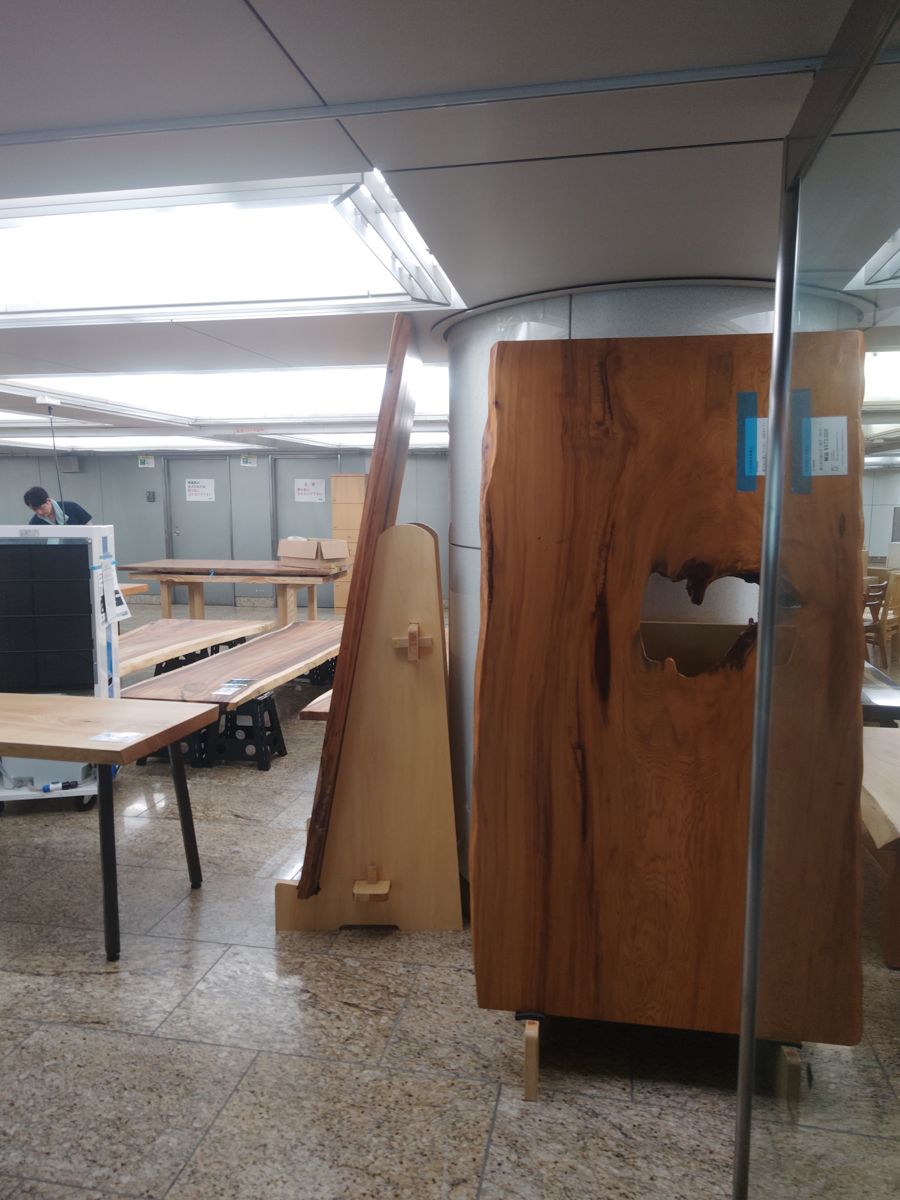
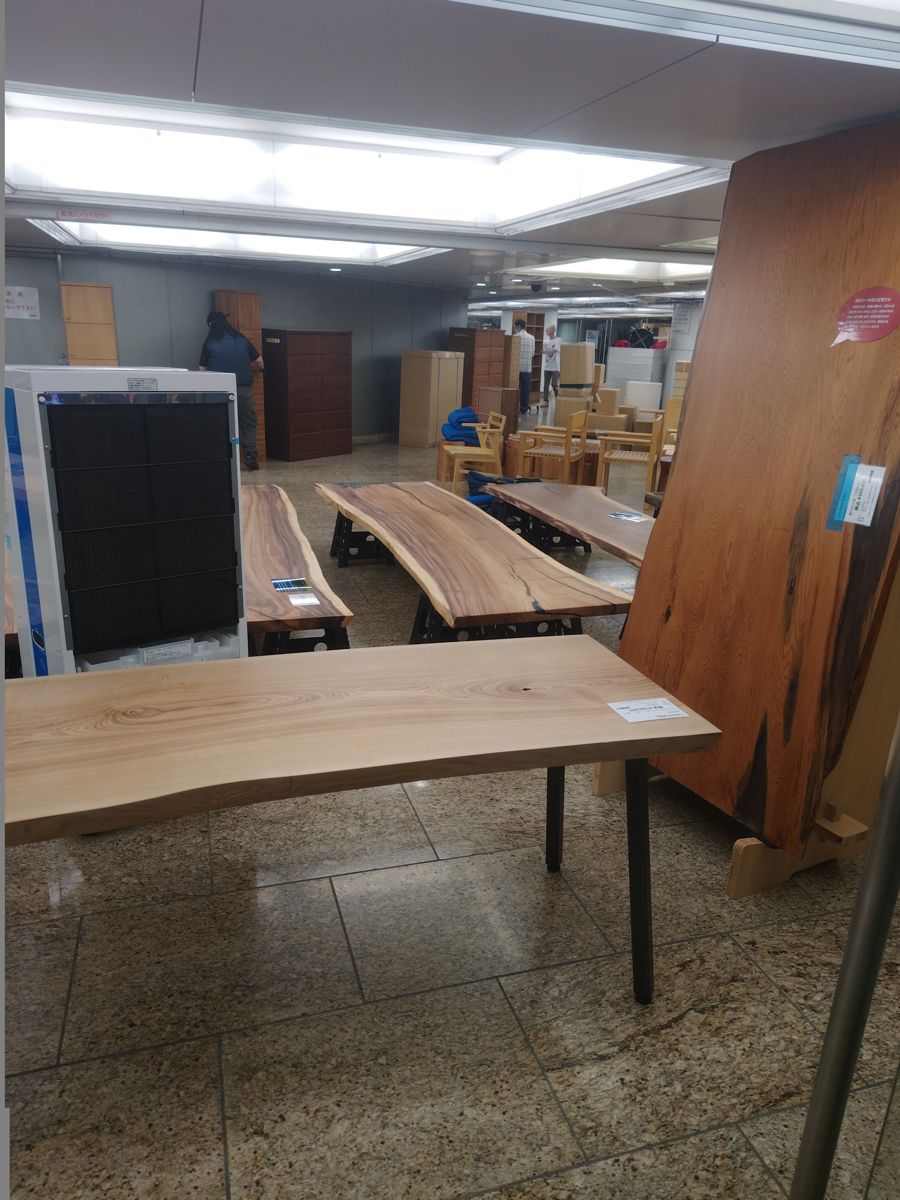
Single-piece slabs sawn from large trees remain popular. In July 2026, a slab sale was held in the event space beneath JR Shinjuku Station, with boards still bearing their bark-side edges (live edges) and boards with holes where knots had fallen out lined up as tabletops.
Склеивание: клееный брус и CLT
Современные деревянные здания держатся на клееных материалах. Каркас кровли Национального стадиона выполнен из клееного бруса лиственницы и криптомерии, а в помещениях для спортсменов использованы отечественные CLT (панели из перекрёстно уложенных слоёв досок).[3] В префектуре Нагано «клееная составная балка» из бревен лиственницы малого и среднего диаметра (менее 30 см) получила сертификацию министра.[4] Именно возможность превращать тонкие деревья в несущие элементы крупных зданий сделала возможными деревянные здания в центре Токио (глава 5).
Showing it off: furniture that makes use of cracks and rot
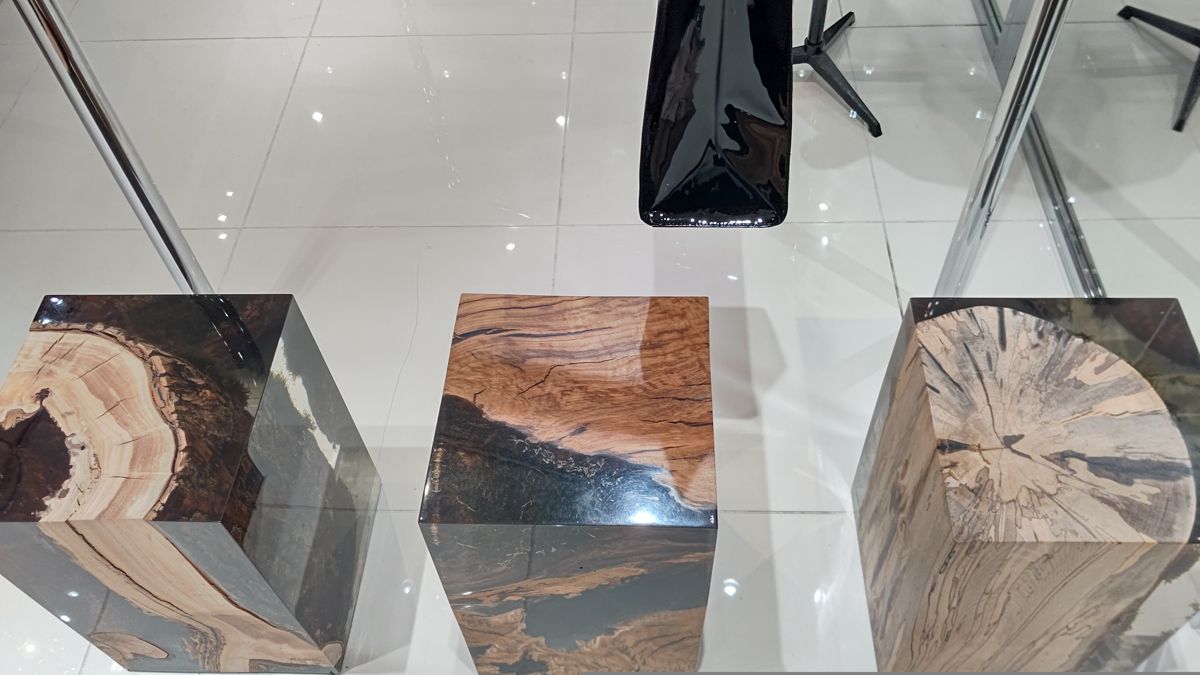
Cracks, rot holes and edges with bark left on are the parts usually cut away in ordinary sawmilling. Set in clear resin, they become furniture that shows those shapes as they are.
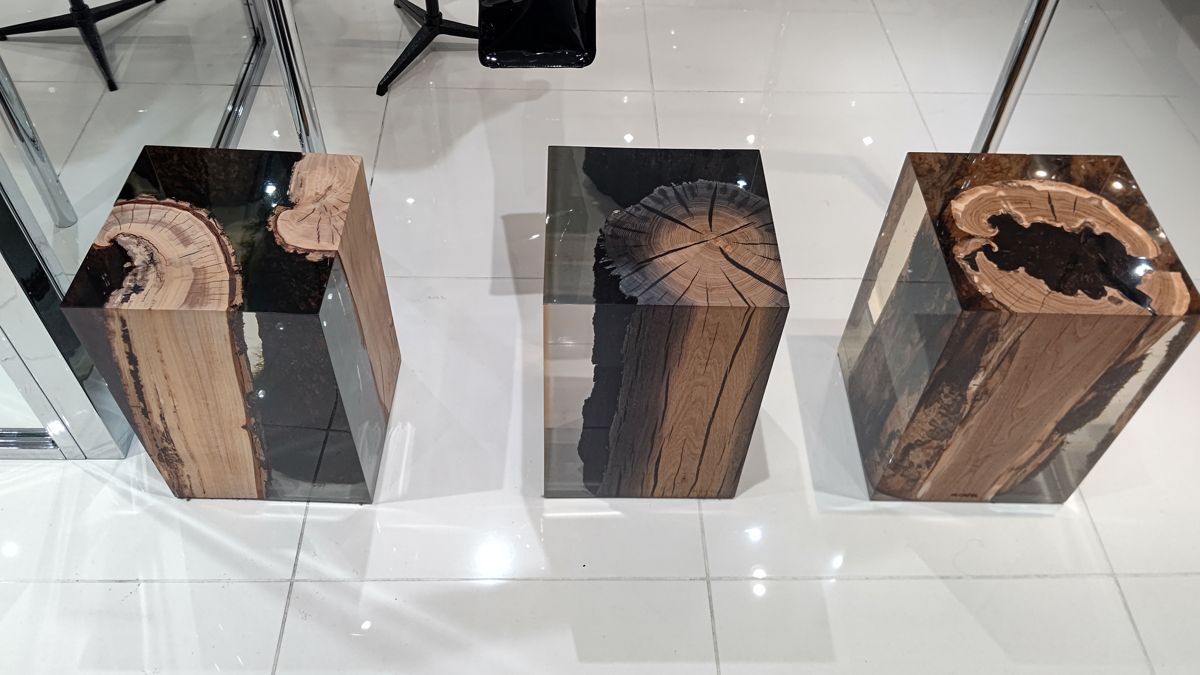
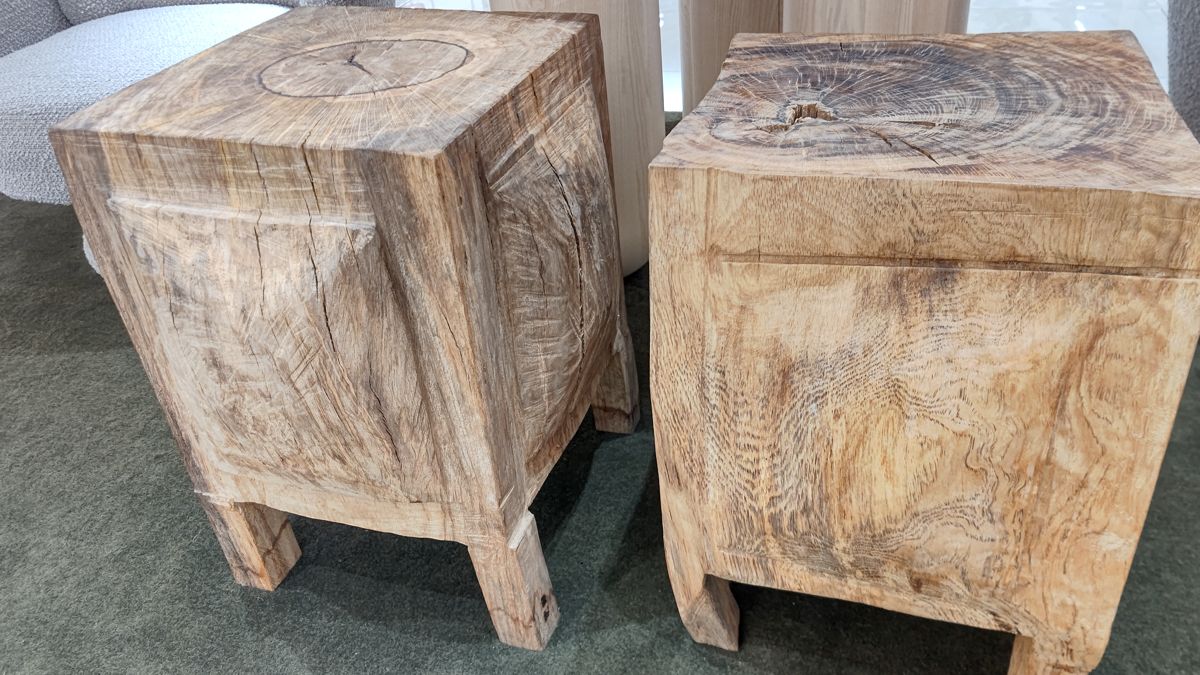
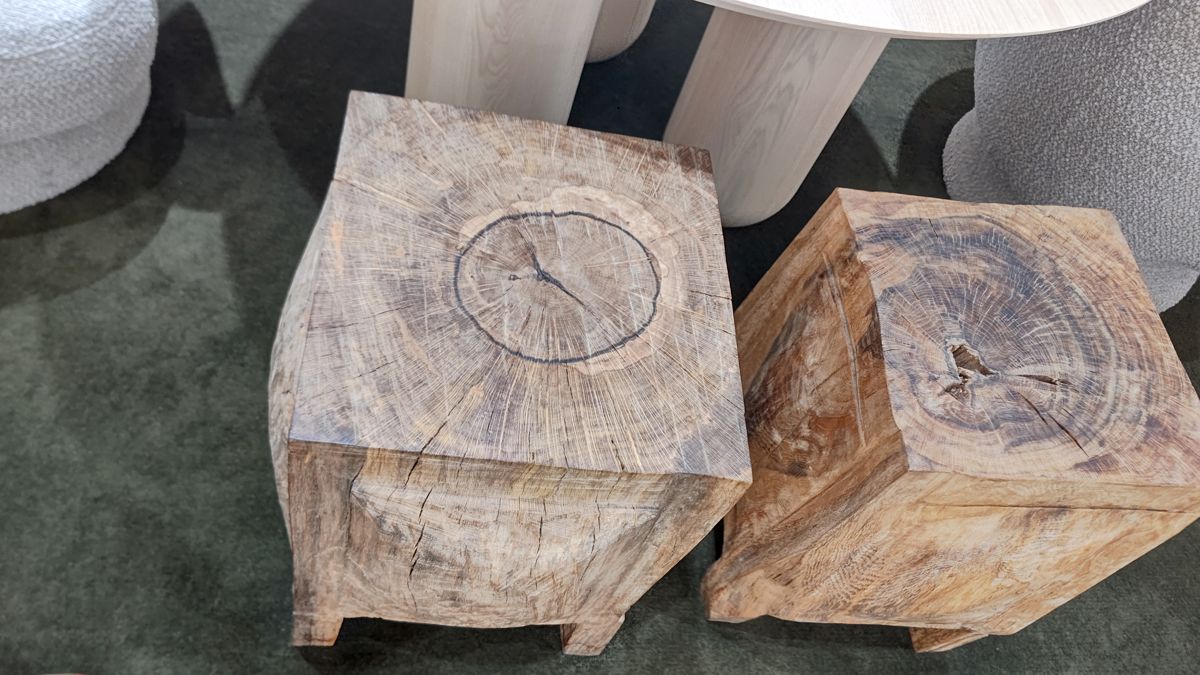
There were also solid-wood stools carved from blocks of log, without resin. The cracks running from the heart of the growth rings and the marks of the cutting tools are left as they are.
Even without making furniture, the shapes of branches and roots themselves can be put on show. In a clothing store in Shibuya, a huge tangle of dried branches and vines hung from the ceiling, spreading over the sales floor.

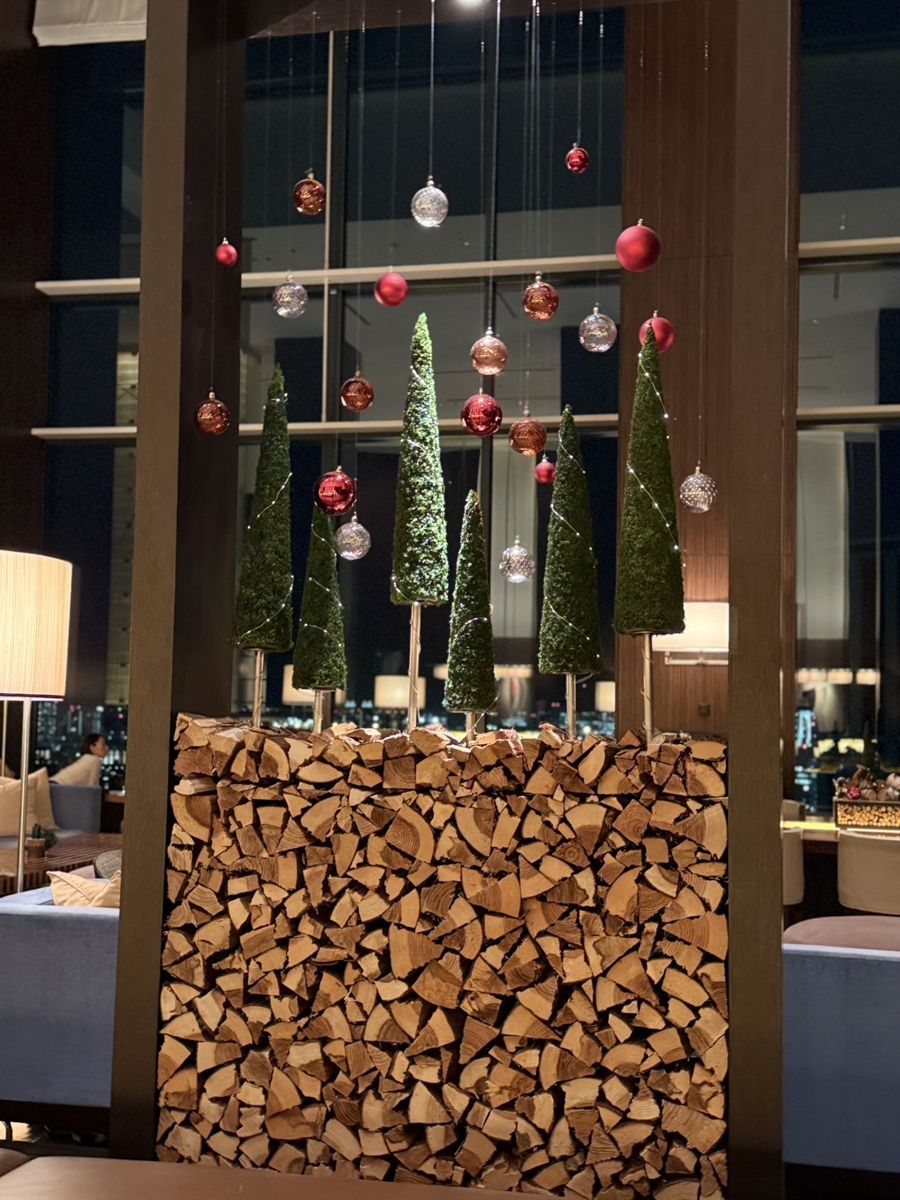
Split firewood, once stacked, becomes decoration in itself. In the lounge of the Conrad Tokyo in Shiodome, small conifer ornaments were lined up on a partition of firewood stacked like a wall.
The resin blocks and solid-wood stools were photographed on the sales floor of a department store in Tokyo with the store's permission. I did not record what kinds of wood and resin were used.
Основание города и судьба срубленных деревьев
Деревянные опоры ЛЭП
Первые в Японии столбы были установлены в 1869 году для государственной телеграфной линии между маячным управлением Иокогамы и судом. С начала эпохи Мэйдзи до эпохи Тайсё столбы делали из дерева.[5]
Деревянные опоры гниют в месте соприкосновения с землёй. В исследовании на Хоккайдо описаны опоры, пропитанные под давлением креозотовым маслом, в основном из ели аянской и пихты сахалинской, а для небольших опор использовалась лиственница. Опоры, установленные в 1958 году, через 22 года утратили антисептик и сильно сгнили, особенно на уровне земли.[6] В отчёте 1981 года отмечается, что в городах уже были распространены бетонные опоры.[6]
Когда и как деревянные опоры Токио заменили бетонными, ещё изучается. Приведённые выше породы и способы обработки — примеры с Хоккайдо.
Засыпка Токийского залива
Значительная часть земли Токио создана засыпкой моря. Вскоре после прихода в Эдо Токугава Иэясу начал засыпать залив Хибия, превратив его в сушу в 1593–1614 годах. Он также срыл холм Канда и его грунтом засыпал территорию от Нихомбаси-Хаматё до Симбаси. Центр порта Эдо разместили в Нихомбаси.[7]
К востоку от реки Сумида засыпка началась в 1596 году. В 1615–1629 годах намывные земли быстро прирастали в восточной части нынешнего района Тюо, включая Рэйгандзиму. Каждый участок окружали каналы, и он становился каси — пристанью для лодок.[7]
История хранения древесины переплетается с этой историей засыпки. Киба эпохи Гэнроку была построена оптовыми лесоторговцами, которые сами засыпали болота Фукагавы (глава 1). Син-Киба, куда она переехала в эпоху Сёва, тоже стоит на намывных землях Токийского залива.
Wood inside the reclaimed land
Wood itself is buried inside the reclaimed land. In postwar Tokyo Port, the sea was filled with garbage, and from 1957 to 1967 garbage was brought to Landfill No. 14—later known as "Yumenoshima" (Dream Island). In a Tokyo Metropolitan Bureau of Port and Harbor survey, "wood, bamboo and straw" made up 13% of the garbage at No. 14.[8] The wood waste of the time was not burned but became part of the material that turned sea into land.
Wood that holds up soft ground: pine piles
On soft, waterlogged ground, wooden piles have long been driven beneath buildings to support them. Beneath the Marunouchi building of Tokyo Station, completed in 1914, about 10,000 pine piles were driven at 0.5 m intervals.[9] Wood rots when exposed to air, but below the groundwater table no oxygen reaches it, so it does not rot and keeps its form for a long time.[10]
Using logs for ground improvement today
Making use of this property, a liquefaction countermeasure that drives thinned logs into the ground has been developed. Logs of sugi, larch and the like—simply debarked and sharpened—are driven into sandy ground to compact it and prevent liquefaction in earthquakes.[11] Because logs placed below the groundwater table do not rot and keep storing carbon, the method is also described as "creating a new forest underground."[10] In a case introduced in a Forestry Agency competition, 570 m³ of thinnings were used.[11] The Tokyo Bay shore, with its many reclaimed areas, is also land at risk of liquefaction, so this is a possible use for Tama thinnings as well.
For "soil improvement" of the surface soil, chips and compost made from pruned branches of street and park trees are used (see "Green recycling" in the next section).
I have not confirmed any case of log-driving liquefaction countermeasures in Tokyo, or any use of Tama timber for them. Nor have I confirmed how Tokyo Station's pine piles were treated in the preservation work.
Куда идёт срубленная древесина
Тама издавна известна как «лесной район Омэ», производящий в основном стойки и жерди для строительных лесов.[12] Сегодня, помимо строительного леса, её древесина идёт также на фанеру (глава 7) и топливо. Здесь отдельно рассмотрены древесина, срубленная в горах, и древесина, срубленная в городе.
Горная древесина как топливо: деревня Хинохара
Деревня Хинохара продолжает превращать собственную древесину в тепло.[13][14]
| Год | Объект | Подробности |
|---|---|---|
| 2012 | Центр горячих источников «Кадзума-но-ю» | Два дровяных котла по 80 кВт установлены наряду с керосиновыми; все примерно 70 т дров, используемых за год, поступают из деревни[13] |
| 2012 | Производство дров | Система сбора древесины и изготовления дров создала рабочие места через Центр занятости пожилых людей; дрова продаются сложенными на поддонах[14] |
| 2017 | Социальное учреждение «Ясураги-но-сато» | Котёл на древесной щепе заменил ископаемое топливо[14] |
Деревня субсидирует валку и вывоз, чтобы древесину от рубок ухода, которую раньше оставляли лежать в горах, можно было вывезти.[14] Использование древесины как топлива позволяет найти применение даже тонким и кривым частям срубленных деревьев.
Городские деревья — обратно городу: зелёная переработка
Ветки и листья от обрезки парковых и уличных деревьев тоже можно использовать. С 1990 финансового года район Кото возвращает ветки и опавшие листья со своих зелёных насаждений обратно в собственные зелёные зоны, а не сжигает и не закапывает их.[15]
| Форма | Применение |
|---|---|
| Щепа | Мягкое покрытие парковых дорожек, мульча для клумб[15] |
| Компост | Раздаётся на мероприятиях района; улучшение почвы в парках и школах[15] |
| Древесина | Таблички с названиями деревьев; материал для поделок в школах и детских садах[15] |
В Токио более миллиона уличных деревьев (глава 8). Как использовать отходы их обрезки — своего рода задача «городского лесного хозяйства».
Laid on park paths: wooden paving of Tama timber
Tama wood is also used underfoot in metropolitan parks. According to a sign by the Tokyo Metropolitan Eastern Park Office that I saw in Ueno Park, the Tokyo government has used Tama timber, including thinnings, for road guard fences, the "Memorial Benches" in metropolitan parks and more, to conserve Tama's deteriorating forests and help prevent global warming. The sign explains that wooden paving will eventually rot and need replacing, but that this keeps thinnings in use and so helps protect the Tama forests.
It is a way of counting rot not as a defect but as a reason to keep using wood. The sign does not say, however, how much wood went into the paving, or whether Tama timber is used again each time it is replaced.
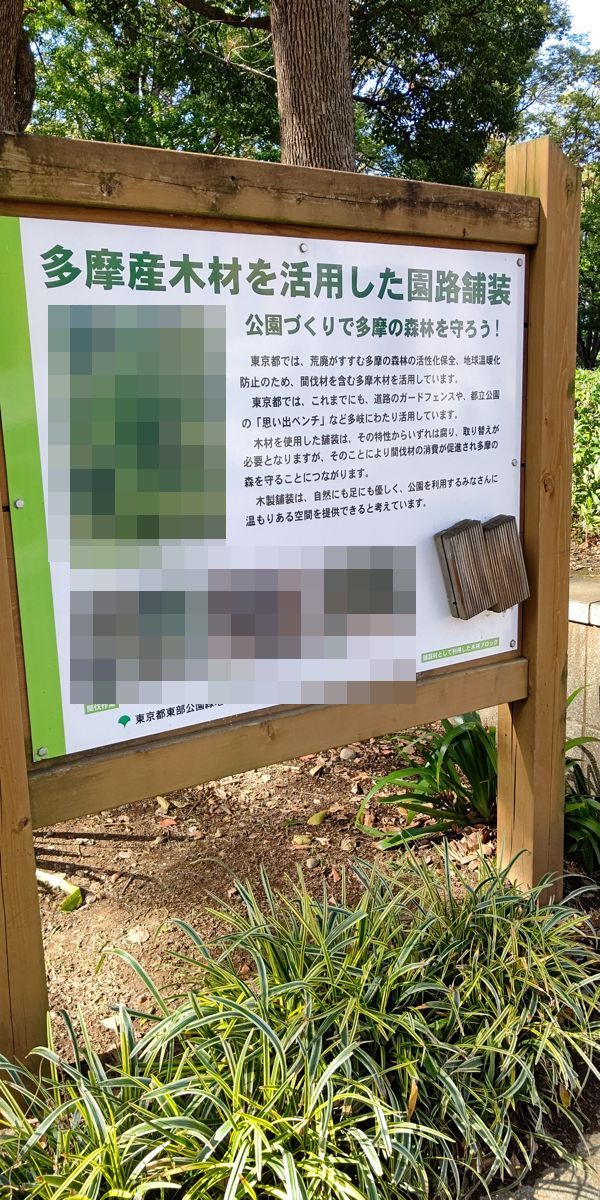
The sign's content is as of October 2021, when the photo was taken. I have not checked the current state of the paving.
Wood crossing the prefectural border: the Otsuki biomass power plant
Felled wood is sometimes carried out of Tokyo. The Otsuki Biomass Power Plant in Otsuki, Yamanashi, has an output of about 14,500 kW, enough electricity for about 30,000 households. It burns about 150,000 tonnes a year of chips made from unused thinnings and pruned branches, mainly from Yamanashi and the wider Kanto region.[16] It began commercial operation in summer 2018.[17]
When the author saw it from a train window in October 2020, logs were piled high in the plant's yard. They were "obstructing trees" (trees felled because they stand in the way of construction) from the building of the Shin-Tomei Expressway (the Second Tomei). Trees cut to build a road were being turned into electricity.
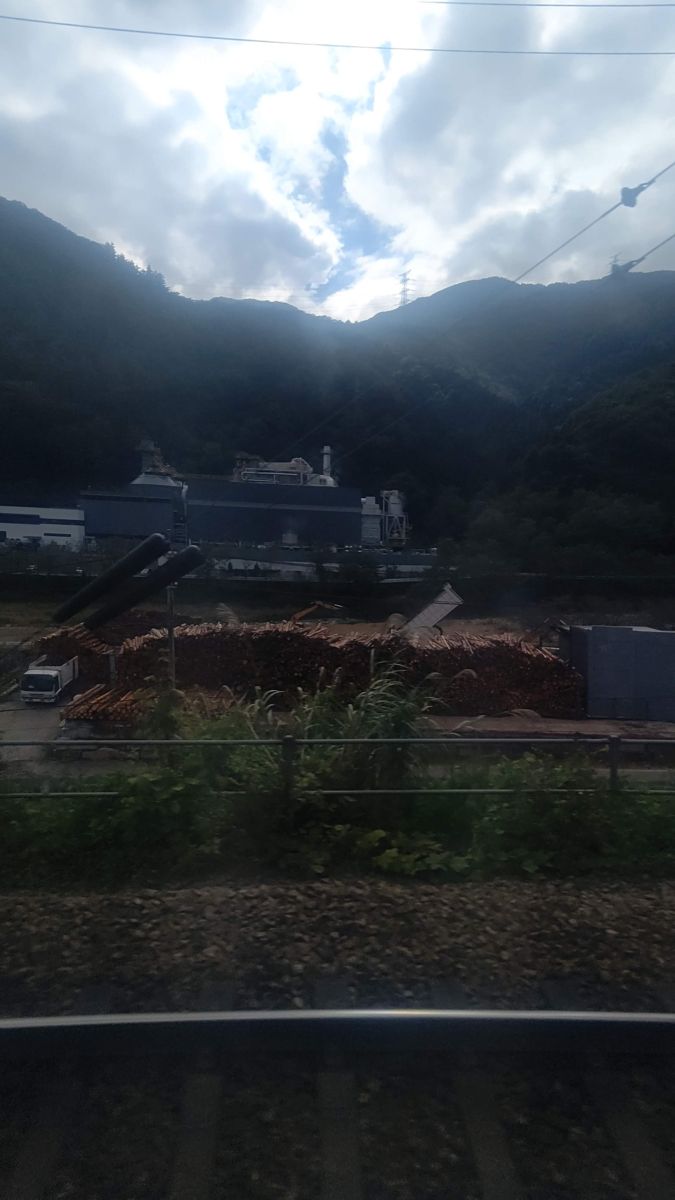
The acceptance of obstructing trees is based on what the author saw and heard on site; it has not been checked against materials from the power plant or the expressway company.
Wood stove smoke: US regulation and Japan
Wood stoves, which burn felled wood as fuel, are being reconsidered as a use for wood. But burning makes smoke, and how countries deal with the fine particles (PM2.5) in that smoke differs greatly.
In the United States, standards under the Clean Air Act set limits on particle emissions from new residential wood stoves offered for sale. The 2015 standard was 4.5 g per hour; from May 2020 it became stricter, at 2.0 or 2.5 g per hour depending on the test method. Stoves that do not meet the standard cannot be sold new.[18] There are also local rules. In the San Francisco Bay Area, burning wood in fireplaces, wood stoves, pellet stoves or outdoor fire pits is illegal on days when a winter air-pollution alert is issued, with fines of $100 for a first violation and $500 for a second.[19] "Changeout" programs that subsidize replacing old stoves with certified ones are also run in many areas. The EPA explains that just 20 old non-certified stoves can emit more than a ton of fine particles during the cold months.[20]
In Japan, there is no law or ordinance regulating smoke or odor from household wood stoves. Neighbor complaints about smoke are treated as civil matters that local governments say they cannot handle. All they can do is "ask" users to burn well-dried wood, not to burn garbage or construction waste, to be considerate of the time of day and surroundings, and to clean their chimneys.[21] With no emission standard for products either, which stove to choose and how to burn it is left to the user.
| United States | Japan | |
|---|---|---|
| Emission standard for new stoves | Yes (2.0–2.5 g/h from 2020)[18] | None |
| Ban on high-pollution days | Depends on area (e.g., Bay Area bans burning on alert days, with fines)[19] | None |
| Neighbor smoke complaints | May be enforced under local rules | A civil matter; local governments can only make requests[21] |
If you use a wood stove in densely built Tokyo, the lack of a Japanese standard does not mean anything goes. How much smoke you produce depends greatly on whether your firewood is well dried and whether your stove burns as cleanly as the US standard requires.
I have not confirmed guidance on wood stoves issued by the Tokyo Metropolitan Government or Tokyo's municipalities, or the number of complaints in Tokyo.
Источники
- 東京都 木育関連リーフレット(令和5年度) PDF
- コトバンク「大鋸」 Ссылка
- 日本スポーツ振興センター「国立競技場について」 PDF
- 長野県林業総合センター 研究トピックス(接着重ね梁) PDF
- 国土交通省 無電柱化に関する資料 PDF
- 北海道立林産試験場『林産試月報』1981年4月号(クレオソート油処理木柱) PDF
- 国土交通省 関東地方整備局 東京港湾事務所「江戸の港」(原典:鈴木理生『江戸の川・東京の川』ほか) PDF
- 東京都港湾局「東京港のごみ埋立地盤の安定化調査について」(平成13年5月) PDF
- 日立製作所「東京駅丸の内駅舎」(日立の技術誌Foresight) PDF
- 日本建設機械施工協会『建設機械施工』Vol.66 No.5「新工法紹介 丸太打設液状化対策工法」(2014年5月) PDF
- 林野庁「Forest Good 2015 間伐・間伐材利用コンクール」(丸太打設液状化対策&カーボンストック工法) PDF
- 東京都「林業・木材産業循環成長対策 変更事業構想」 PDF
- 林野庁『平成28年度 森林・林業白書』事例(檜原村 数馬の湯) Ссылка
- 環境情報センター(EIC)「首長に聞く」檜原村 Ссылка
- 江東区「緑のリサイクル」 Ссылка
- 大林組 ニュースリリース「大月バイオマス発電所の建設に着手」(2016年8月4日) Ссылка
- 大林組 ニュースリリース(2018年6月1日、大月バイオマス発電所の営業運転開始) Ссылка
- 米国環境保護庁(EPA)「EPA Certified Wood Stoves」 Ссылка
- ベイエリア大気質管理地区(BAAQMD)「Winter Spare the Air」(2024年11月30日) Ссылка
- EPA「Implementing Wood-Burning Changeout Campaigns and Examples of Programs」 Ссылка
- 柏市「家庭用薪ストーブの使用」(2026年1月16日更新) Ссылка