Introdução / Capítulo 6
Beneficiamento e obras civis
As toras não podem ser usadas como estão. Precisam ser fendidas, serradas ou laminadas. Este capítulo acompanha como a madeira foi beneficiada do período Edo até hoje e como foi usada em obras civis, como postes e aterros.
Trabalhar a madeira
Fender: mais antigo que a serra
O cedro cresce reto e se fende com facilidade ao longo dos veios. Pode ser fendido em lâminas de até cerca de 5 mm e era usado para barris e tinas.[1] As antigas serras japonesas eram ferramentas de corte transversal, pouco adequadas para serrar a madeira no sentido do comprimento.[2] Por isso a madeira fácil de fender era tão valorizada.
Serrar: o oga e o maebiki-oga
O oga, serra para cortar a madeira no sentido do comprimento, veio da China nos séculos XIV e XV (meados do período Muromachi). Sua lâmina, com cerca de 2 m de comprimento e 5 cm de largura, era tensionada em uma armação e manejada por duas pessoas.[2] Ela facilitou o corte de tábuas largas e finas, transformando a fabricação de tábuas e a marcenaria.[2]
No início do período Edo surgiu e se difundiu o maebiki-oga, manejado por uma só pessoa.[2] Os artesãos que serravam toras em tábuas e madeira esquadriada eram chamados kobiki, serradores.
| Método | Época | O que faz |
|---|---|---|
| Fender | Desde a Antiguidade | Fender toras retas no sentido do comprimento; aduelas para barris e tinas[1] |
| Oga (para duas pessoas) | Introduzido nos séc. XIV–XV | Serrar ao comprido tábuas largas e finas[2] |
| Maebiki-oga (para uma pessoa) | Difundido no início do período Edo | Um serrador corta sozinho ao comprido[2] |
| Madeira laminada colada / CLT | Hoje | Peças pequenas laminadas para formar grandes pilares, vigas e paredes[3] |
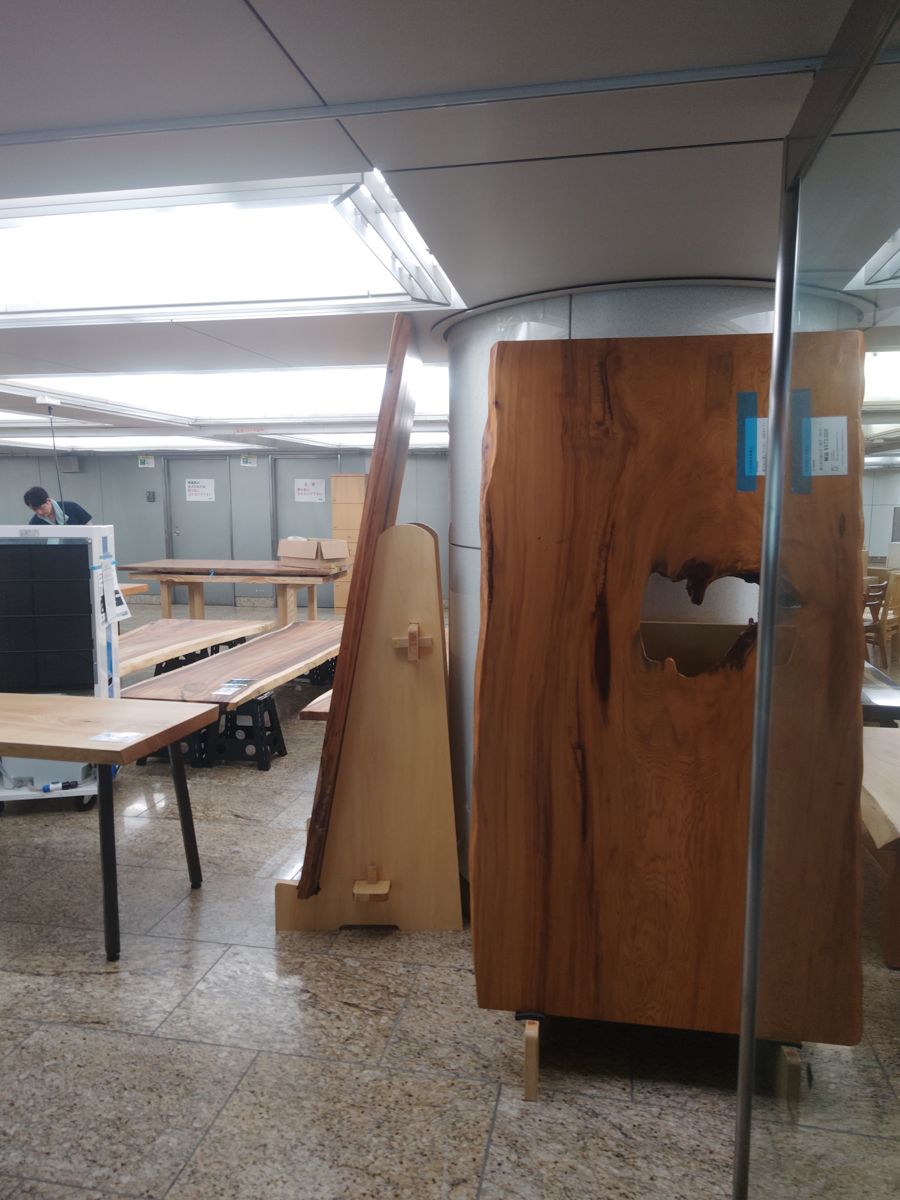
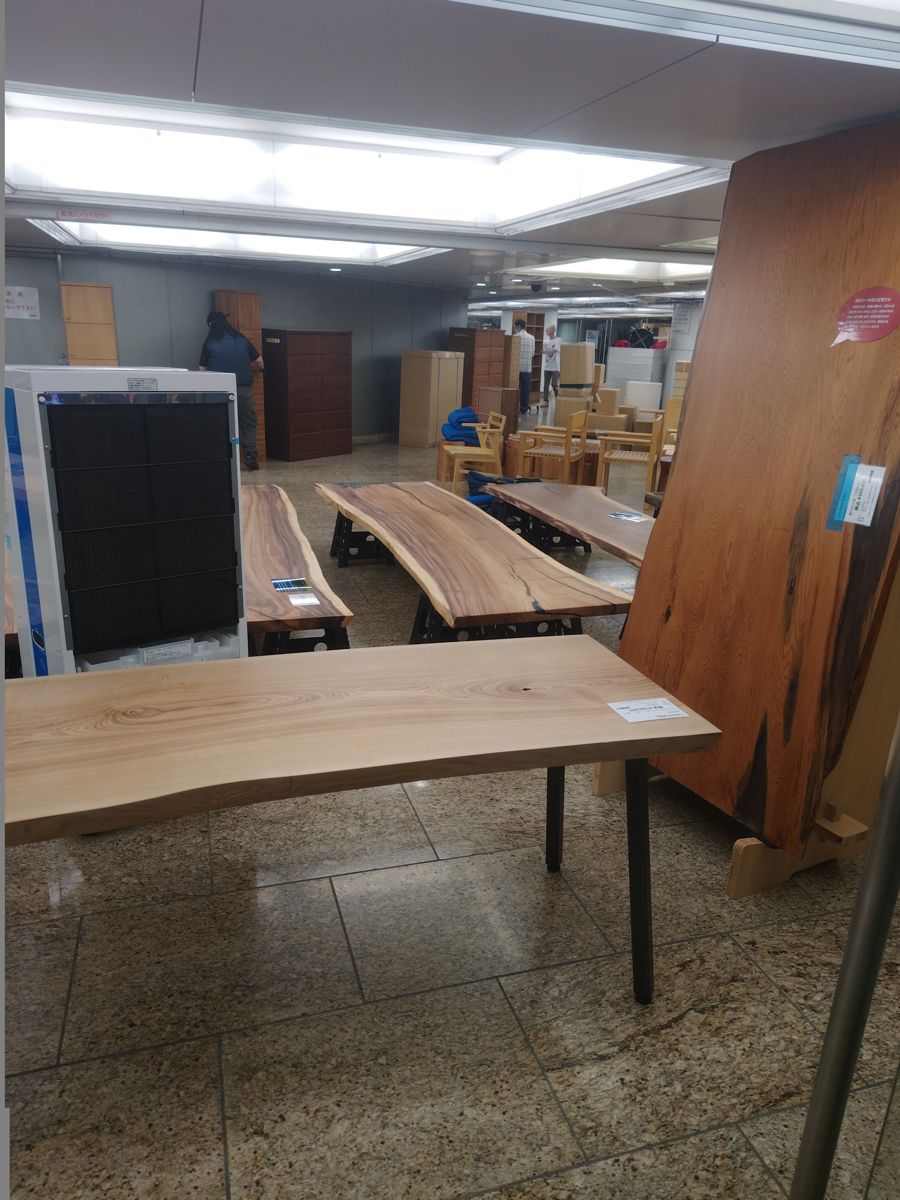
Single-piece slabs sawn from large trees remain popular. In July 2026, a slab sale was held in the event space beneath JR Shinjuku Station, with boards still bearing their bark-side edges (live edges) and boards with holes where knots had fallen out lined up as tabletops.
Laminar: madeira laminada colada e CLT
Os edifícios de madeira de hoje se apoiam em materiais laminados. A estrutura da cobertura do Estádio Nacional usa madeira laminada colada de lariço e cedro, e as instalações dos atletas usam CLT nacional (painéis de tábuas sobrepostas em camadas cruzadas).[3] Na Província de Nagano, uma "viga empilhada colada" feita de toras de lariço de diâmetro pequeno e médio, com menos de 30 cm, recebeu certificação ministerial.[4] Poder transformar árvores finas em peças estruturais para grandes edifícios é o que tornou possíveis os edifícios de madeira no centro de Tóquio (Capítulo 5).
Showing it off: furniture that makes use of cracks and rot
Cracks, rot holes and edges with bark left on are the parts usually cut away in ordinary sawmilling. Set in clear resin, they become furniture that shows those shapes as they are.
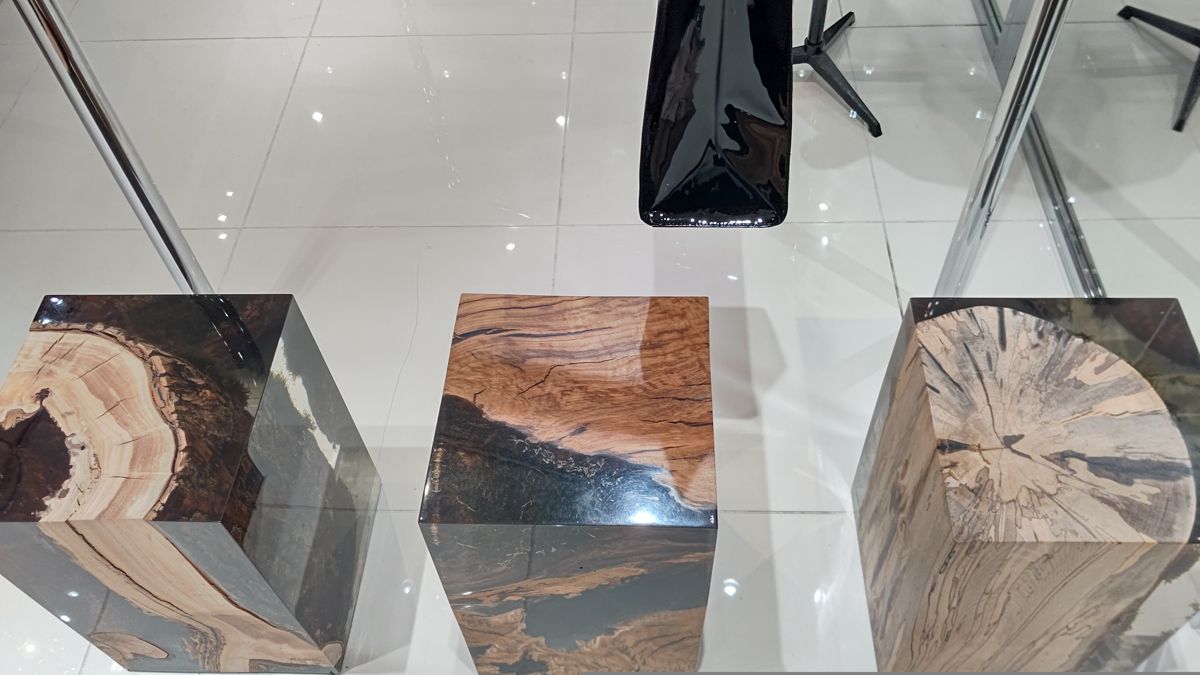
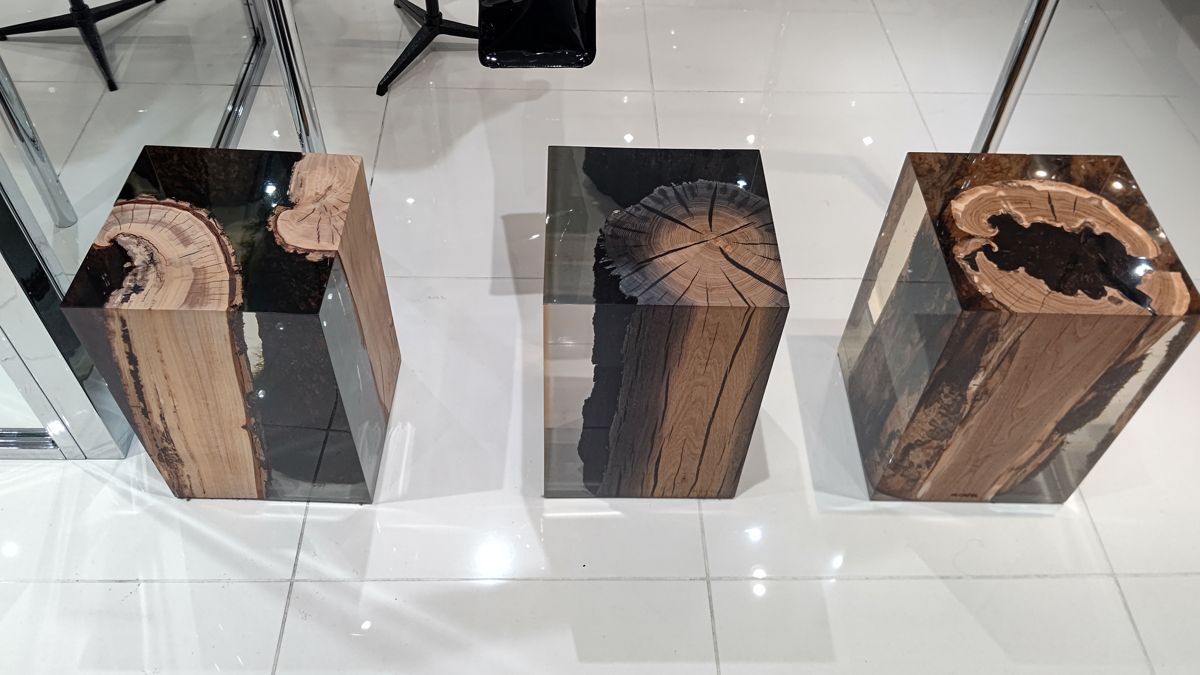
There were also solid-wood stools carved from blocks of log, without resin. The cracks running from the heart of the growth rings and the marks of the cutting tools are left as they are.
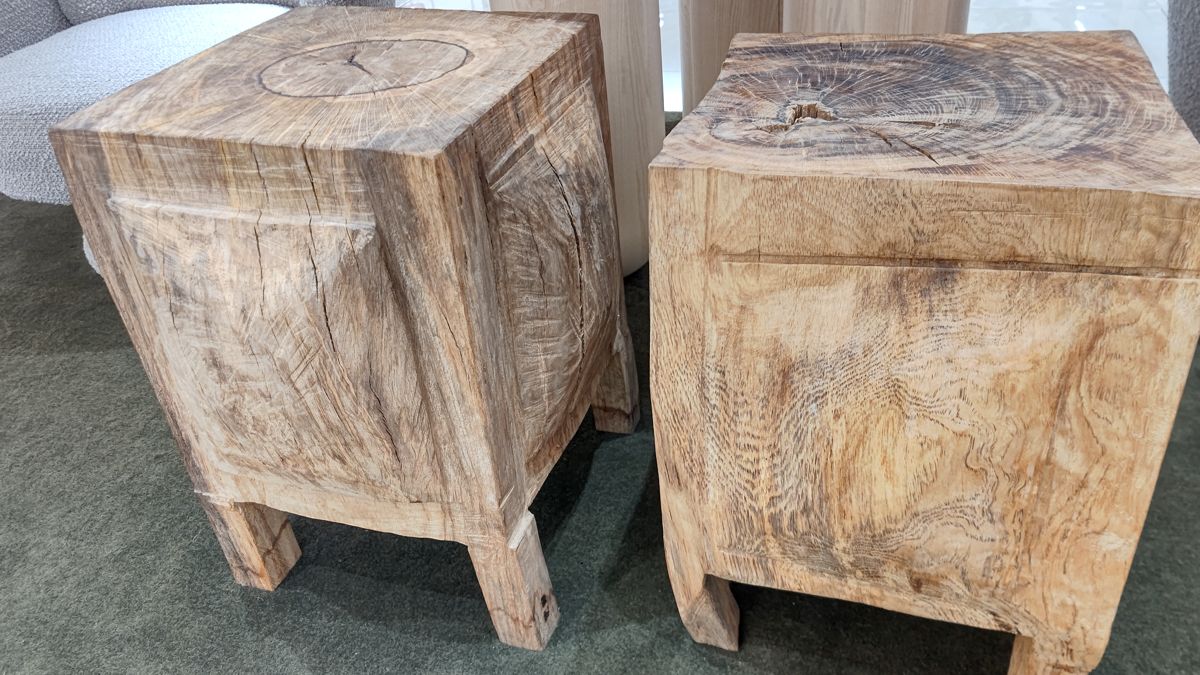
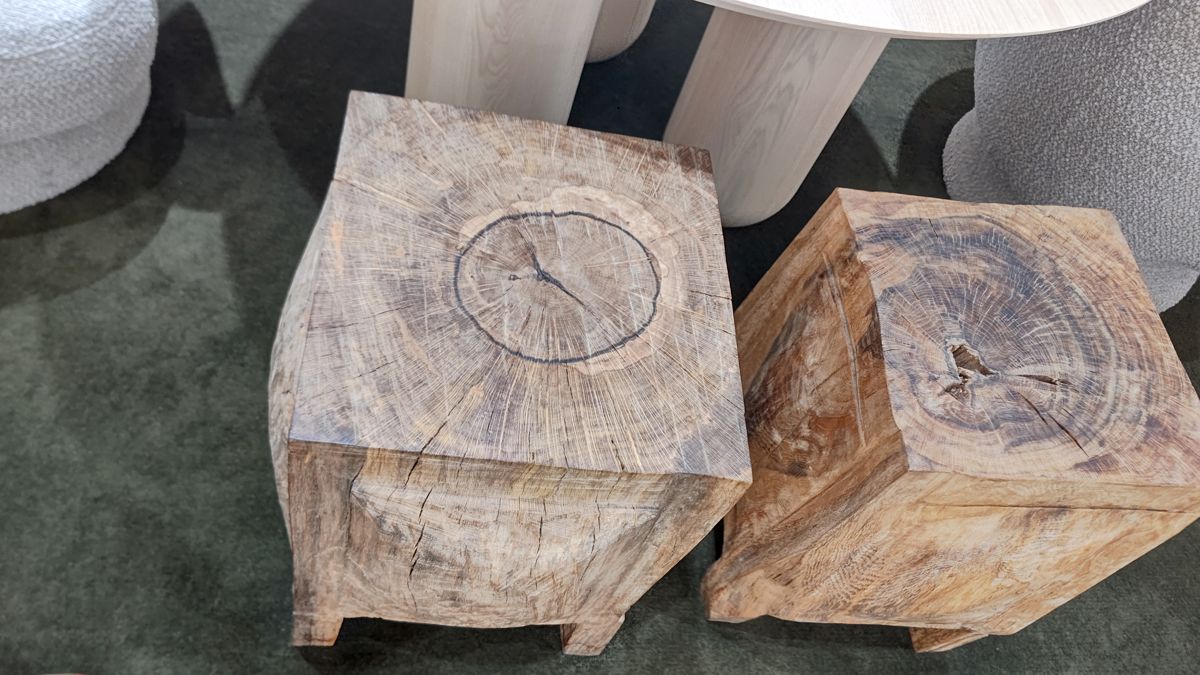
Even without making furniture, the shapes of branches and roots themselves can be put on show. In a clothing store in Shibuya, a huge tangle of dried branches and vines hung from the ceiling, spreading over the sales floor.

Split firewood, once stacked, becomes decoration in itself. In the lounge of the Conrad Tokyo in Shiodome, small conifer ornaments were lined up on a partition of firewood stacked like a wall.
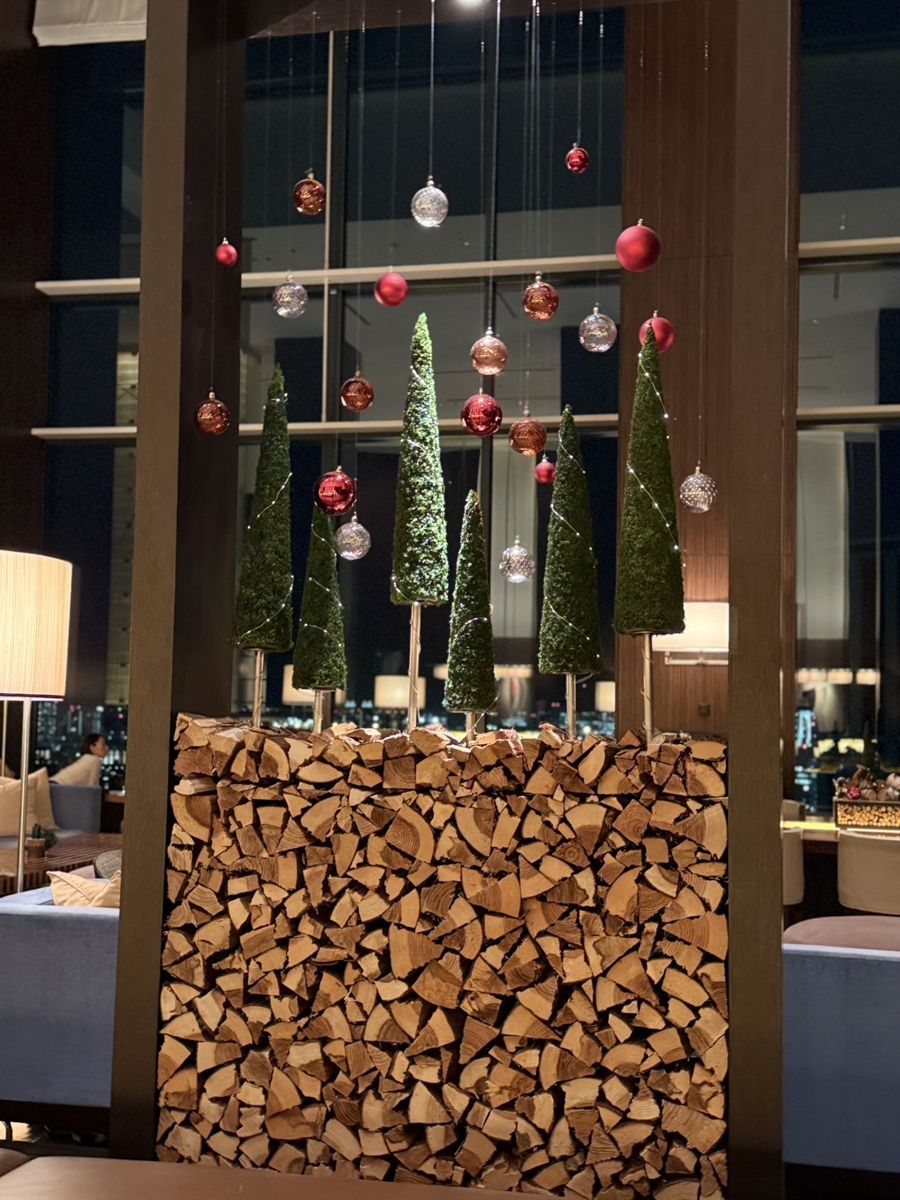
The resin blocks and solid-wood stools were photographed on the sales floor of a department store in Tokyo with the store's permission. I did not record what kinds of wood and resin were used.
As fundações da cidade e o destino das árvores cortadas
Postes de madeira
Os primeiros postes do Japão foram erguidos em 1869 para levar uma linha telegráfica oficial entre o escritório do farol de Yokohama e o tribunal. Do início da era Meiji à era Taisho, os postes eram de madeira.[5]
Os postes de madeira apodrecem no ponto em que tocam o solo. Um estudo de Hokkaido descreve postes tratados sob pressão com creosoto, principalmente de abeto-de-yezo e abeto-de-sacalina, com lariço usado nos postes pequenos. Postes erguidos em 1958 haviam perdido o preservativo 22 anos depois e estavam muito deteriorados, sobretudo na altura do solo.[6] O relatório, de 1981, observa que os postes de concreto já eram comuns nas áreas urbanas.[6]
Quando e como os postes de madeira de Tóquio foram substituídos por concreto ainda está em pesquisa. As espécies e o tratamento acima são exemplos de Hokkaido.
Os aterros da baía de Tóquio
Grande parte do território de Tóquio foi feita aterrando o mar. Logo depois de entrar em Edo, Tokugawa Ieyasu começou a aterrar a enseada de Hibiya, transformando-a em terra entre 1593 e 1614. Também mandou rebaixar a colina de Kanda e usou sua terra para aterrar a área de Nihonbashi-Hamacho a Shinbashi. O centro do porto de Edo foi instalado em Nihonbashi.[7]
A leste do rio Sumida, os aterros começaram em 1596. Entre 1615 e 1629, as terras aterradas aumentaram rapidamente no atual leste do distrito de Chuo, incluindo Reiganjima. Cada lote era cercado por canais e tornava-se um kashi, um cais para barcos.[7]
O armazenamento de madeira se entrelaça com essa história de aterros. A Kiba da era Genroku foi construída por atacadistas de madeira que aterraram eles mesmos os pântanos de Fukagawa (Capítulo 1). Shin-Kiba, para onde ela se mudou na era Showa, também fica em um aterro da baía de Tóquio.
Wood inside the reclaimed land
Wood itself is buried inside the reclaimed land. In postwar Tokyo Port, the sea was filled with garbage, and from 1957 to 1967 garbage was brought to Landfill No. 14—later known as "Yumenoshima" (Dream Island). In a Tokyo Metropolitan Bureau of Port and Harbor survey, "wood, bamboo and straw" made up 13% of the garbage at No. 14.[8] The wood waste of the time was not burned but became part of the material that turned sea into land.
Wood that holds up soft ground: pine piles
On soft, waterlogged ground, wooden piles have long been driven beneath buildings to support them. Beneath the Marunouchi building of Tokyo Station, completed in 1914, about 10,000 pine piles were driven at 0.5 m intervals.[9] Wood rots when exposed to air, but below the groundwater table no oxygen reaches it, so it does not rot and keeps its form for a long time.[10]
Using logs for ground improvement today
Making use of this property, a liquefaction countermeasure that drives thinned logs into the ground has been developed. Logs of sugi, larch and the like—simply debarked and sharpened—are driven into sandy ground to compact it and prevent liquefaction in earthquakes.[11] Because logs placed below the groundwater table do not rot and keep storing carbon, the method is also described as "creating a new forest underground."[10] In a case introduced in a Forestry Agency competition, 570 m³ of thinnings were used.[11] The Tokyo Bay shore, with its many reclaimed areas, is also land at risk of liquefaction, so this is a possible use for Tama thinnings as well.
For "soil improvement" of the surface soil, chips and compost made from pruned branches of street and park trees are used (see "Green recycling" in the next section).
I have not confirmed any case of log-driving liquefaction countermeasures in Tokyo, or any use of Tama timber for them. Nor have I confirmed how Tokyo Station's pine piles were treated in the preservation work.
Para onde vai a madeira derrubada
Tama é conhecida há muito tempo como o "distrito florestal de Ome", que produzia principalmente pilares e varas para andaimes.[12] Hoje, além da madeira de construção, sua madeira também vai para compensado (Capítulo 7) e combustível. Aqui olhamos separadamente para a madeira cortada nas montanhas e a madeira cortada na cidade.
Madeira da montanha como combustível: a vila de Hinohara
A vila de Hinohara continua transformando sua própria madeira em calor.[13][14]
| Ano | Instalação | Detalhes |
|---|---|---|
| 2012 | Centro de águas termais Kazuma no Yu | Duas caldeiras a lenha de 80 kW instaladas ao lado de caldeiras a querosene; toda a lenha usada por ano, cerca de 70 t, vem da vila[13] |
| 2012 | Produção de lenha | Um sistema de coleta de madeira e produção de lenha criou empregos por meio do Centro de Recursos Humanos Sênior; a lenha é vendida empilhada em paletes[14] |
| 2017 | Instalação de assistência social Yasuragi no Sato | Uma caldeira a cavacos de madeira substituiu os combustíveis fósseis[14] |
A vila subsidia a derrubada e o arraste para que a madeira de desbaste, antes deixada nas montanhas, possa ser retirada.[14] Usar a madeira como combustível dá destino até às partes finas e tortas das árvores derrubadas.
Devolvendo as árvores da cidade à cidade: reciclagem de resíduos verdes
Galhos e folhas da poda de parques e árvores de rua também podem ser aproveitados. Desde o AF 1990, o distrito de Koto devolve às suas próprias áreas verdes os galhos e folhas caídas de sua vegetação, em vez de queimá-los ou enterrá-los.[15]
| Forma | Uso |
|---|---|
| Cavacos | Amortecimento de trilhas de parques, cobertura morta em canteiros[15] |
| Composto | Distribuído em eventos do distrito; melhoria do solo em parques e escolas[15] |
| Madeira | Placas com nomes de árvores; material de artesanato para escolas e jardins de infância[15] |
Tóquio tem mais de um milhão de árvores de rua (Capítulo 8). Como aproveitar a poda delas é uma espécie de desafio de "silvicultura urbana".
Laid on park paths: wooden paving of Tama timber
Tama wood is also used underfoot in metropolitan parks. According to a sign by the Tokyo Metropolitan Eastern Park Office that I saw in Ueno Park, the Tokyo government has used Tama timber, including thinnings, for road guard fences, the "Memorial Benches" in metropolitan parks and more, to conserve Tama's deteriorating forests and help prevent global warming. The sign explains that wooden paving will eventually rot and need replacing, but that this keeps thinnings in use and so helps protect the Tama forests.
It is a way of counting rot not as a defect but as a reason to keep using wood. The sign does not say, however, how much wood went into the paving, or whether Tama timber is used again each time it is replaced.
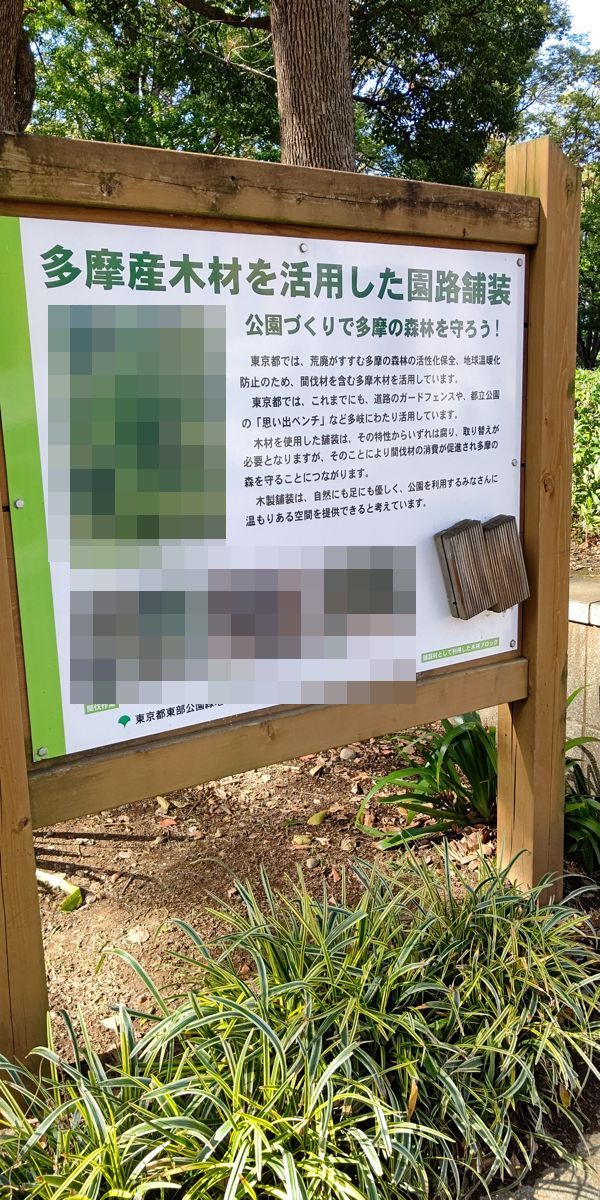
The sign's content is as of October 2021, when the photo was taken. I have not checked the current state of the paving.
Wood crossing the prefectural border: the Otsuki biomass power plant
Felled wood is sometimes carried out of Tokyo. The Otsuki Biomass Power Plant in Otsuki, Yamanashi, has an output of about 14,500 kW, enough electricity for about 30,000 households. It burns about 150,000 tonnes a year of chips made from unused thinnings and pruned branches, mainly from Yamanashi and the wider Kanto region.[16] It began commercial operation in summer 2018.[17]
When the author saw it from a train window in October 2020, logs were piled high in the plant's yard. They were "obstructing trees" (trees felled because they stand in the way of construction) from the building of the Shin-Tomei Expressway (the Second Tomei). Trees cut to build a road were being turned into electricity.
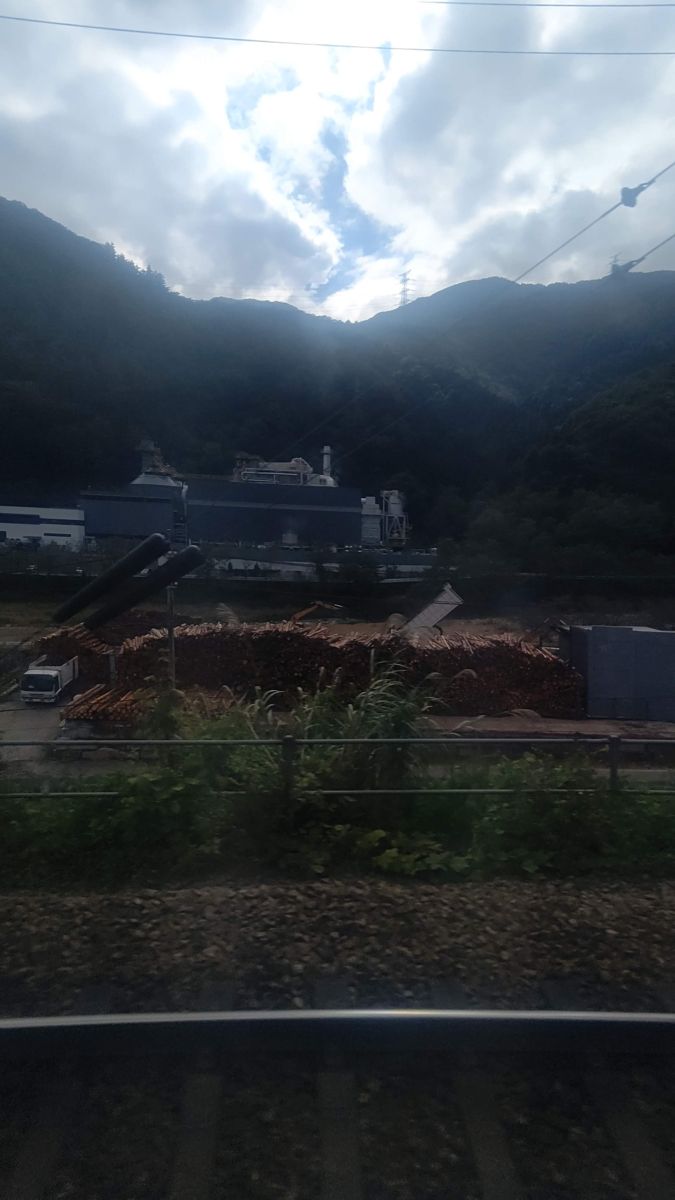
The acceptance of obstructing trees is based on what the author saw and heard on site; it has not been checked against materials from the power plant or the expressway company.
Wood stove smoke: US regulation and Japan
Wood stoves, which burn felled wood as fuel, are being reconsidered as a use for wood. But burning makes smoke, and how countries deal with the fine particles (PM2.5) in that smoke differs greatly.
In the United States, standards under the Clean Air Act set limits on particle emissions from new residential wood stoves offered for sale. The 2015 standard was 4.5 g per hour; from May 2020 it became stricter, at 2.0 or 2.5 g per hour depending on the test method. Stoves that do not meet the standard cannot be sold new.[18] There are also local rules. In the San Francisco Bay Area, burning wood in fireplaces, wood stoves, pellet stoves or outdoor fire pits is illegal on days when a winter air-pollution alert is issued, with fines of $100 for a first violation and $500 for a second.[19] "Changeout" programs that subsidize replacing old stoves with certified ones are also run in many areas. The EPA explains that just 20 old non-certified stoves can emit more than a ton of fine particles during the cold months.[20]
In Japan, there is no law or ordinance regulating smoke or odor from household wood stoves. Neighbor complaints about smoke are treated as civil matters that local governments say they cannot handle. All they can do is "ask" users to burn well-dried wood, not to burn garbage or construction waste, to be considerate of the time of day and surroundings, and to clean their chimneys.[21] With no emission standard for products either, which stove to choose and how to burn it is left to the user.
| United States | Japan | |
|---|---|---|
| Emission standard for new stoves | Yes (2.0–2.5 g/h from 2020)[18] | None |
| Ban on high-pollution days | Depends on area (e.g., Bay Area bans burning on alert days, with fines)[19] | None |
| Neighbor smoke complaints | May be enforced under local rules | A civil matter; local governments can only make requests[21] |
If you use a wood stove in densely built Tokyo, the lack of a Japanese standard does not mean anything goes. How much smoke you produce depends greatly on whether your firewood is well dried and whether your stove burns as cleanly as the US standard requires.
I have not confirmed guidance on wood stoves issued by the Tokyo Metropolitan Government or Tokyo's municipalities, or the number of complaints in Tokyo.
Fontes
- 東京都 木育関連リーフレット(令和5年度) PDF
- コトバンク「大鋸」 Link
- 日本スポーツ振興センター「国立競技場について」 PDF
- 長野県林業総合センター 研究トピックス(接着重ね梁) PDF
- 国土交通省 無電柱化に関する資料 PDF
- 北海道立林産試験場『林産試月報』1981年4月号(クレオソート油処理木柱) PDF
- 国土交通省 関東地方整備局 東京港湾事務所「江戸の港」(原典:鈴木理生『江戸の川・東京の川』ほか) PDF
- 東京都港湾局「東京港のごみ埋立地盤の安定化調査について」(平成13年5月) PDF
- 日立製作所「東京駅丸の内駅舎」(日立の技術誌Foresight) PDF
- 日本建設機械施工協会『建設機械施工』Vol.66 No.5「新工法紹介 丸太打設液状化対策工法」(2014年5月) PDF
- 林野庁「Forest Good 2015 間伐・間伐材利用コンクール」(丸太打設液状化対策&カーボンストック工法) PDF
- 東京都「林業・木材産業循環成長対策 変更事業構想」 PDF
- 林野庁『平成28年度 森林・林業白書』事例(檜原村 数馬の湯) Link
- 環境情報センター(EIC)「首長に聞く」檜原村 Link
- 江東区「緑のリサイクル」 Link
- 大林組 ニュースリリース「大月バイオマス発電所の建設に着手」(2016年8月4日) Link
- 大林組 ニュースリリース(2018年6月1日、大月バイオマス発電所の営業運転開始) Link
- 米国環境保護庁(EPA)「EPA Certified Wood Stoves」 Link
- ベイエリア大気質管理地区(BAAQMD)「Winter Spare the Air」(2024年11月30日) Link
- EPA「Implementing Wood-Burning Changeout Campaigns and Examples of Programs」 Link
- 柏市「家庭用薪ストーブの使用」(2026年1月16日更新) Link